Home / GU oncology / UTUC / Adjuvant after nephroureterectomy
Upper tract urothelial carcinoma → Adjuvant treatment after nephroureterectomy
current — POUT supports adjuvant gemcitabine–platinum for its eligible postoperative population
Evidence page
Who this applies to
| Population | Exact POUT boundary | Noneligible boundary |
|---|---|---|
| Resected high-risk UTUC | Predominantly transitional-cell UTUC after en-bloc radical nephroureterectomy; pT2–pT4, any N, M0 or pT any, N1–3, M01. | Metastatic disease, residual lymphadenopathy when postoperative imaging was required, or disease outside these pathologic criteria1. |
| Fit for postoperative platinum | Treatment began within 90 days; satisfactory hematologic/biochemical profile; GFR ≥30 mL/min1. | Do not generalize the protocol to frail patients with preserved GFR but another cisplatin contraindication14. |
| Protocol platinum selection | GFR ≥50: gemcitabine–cisplatin; GFR 30–49: gemcitabine–carboplatin1. | POUT was not designed to compare cisplatin with carboplatin1. |
Standard options
| Clinical context | Option | Key inclusion | Typical course |
|---|---|---|---|
| pT2–T4 and/or pN+ UTUC after RNU, no prior neoadjuvant platinum | Adjuvant gemcitabine–platinum1 | POUT eligibility and organ function1. | Four 21-day cycles beginning within 90 days after RNU1. |
| No prior bladder cancer after RNU | Single postoperative intravesical chemotherapy34 | Bladder-recurrence prevention, not systemic recurrence treatment34. | Separate perioperative intervention per guideline34. |
| Platinum-ineligible or declining platinum, high-risk UC | Discuss adjuvant nivolumab only with explicit evidence boundary46 | Regulatory all-MIUC option; UTUC subgroup benefit was not established in the retrieved guideline46. | Individualized46. |
Therapy sequencing
| Postoperative state | Next treatment order | Branch point / evidence boundary |
|---|---|---|
| pT2–T4 and/or pN+ UTUC after RNU, no prior neoadjuvant platinum | Start four cycles of adjuvant gemcitabine–platinum within the POUT postoperative window1. | This is the direct POUT sequence; it does not compare adjuvant chemotherapy with neoadjuvant chemotherapy1. |
| Post-RNU GFR ≥50 mL/min | Gemcitabine–cisplatin1. | This is POUT protocol selection, not a universal cisplatin eligibility definition1. |
| Post-RNU GFR 30–49 mL/min | Gemcitabine–carboplatin1. | POUT was not designed to compare cisplatin with carboplatin1. |
| Platinum-ineligible or declining, high-risk disease | Discuss nivolumab or trial/surveillance with explicit UTUC evidence limits46. | CheckMate 274 is all-MIUC; do not claim an unreported UTUC subgroup efficacy result46. |
| No prior bladder cancer after RNU | Deliver the separate single intravesical postoperative chemotherapy intervention34. | This reduces bladder recurrence; it is not systemic recurrence treatment34. |
Surveillance and treatment de-escalation
Post-RNU imaging and cystoscopy schedule
| Modality | Through 24 months | Years 3–5 | Notes |
|---|---|---|---|
| CT chest/abdomen/pelvis4 | Every 6 months × 2 years4 | Annually4 | EAU UTUC surveillance framework4. |
| Cystoscopy (bladder-recurrence surveillance)14 | Every 6 months × 2 years1 | Annually through 60 months1 | POUT methods schedule for lower-tract recurrence; EAU likewise emphasizes bladder surveillance after RNU14. |
| Phase | Monitoring cadence | Stop, hold, or de-escalate | Re-escalation / next line |
|---|---|---|---|
| After RNU (surveillance arm or post-chemo) | CT and cystoscopy per schedule above; single postoperative intravesical chemotherapy when indicated134. | Complete four cycles of adjuvant gemcitabine–platinum within 90 days if selected; then surveillance only14. | Local recurrence → re-resection when feasible; metastatic recurrence → systemic therapy (metastatic UTUC/mUC page)46. |
| On adjuvant gemcitabine–platinum | CBC, renal function, electrolytes each cycle; audiometry if cisplatin14. | Stop after four cycles per POUT; hold for febrile neutropenia or renal decline1. | Progression on therapy → systemic second-line options; platinum-ineligible may discuss nivolumab with explicit all-MIUC evidence boundary46. |
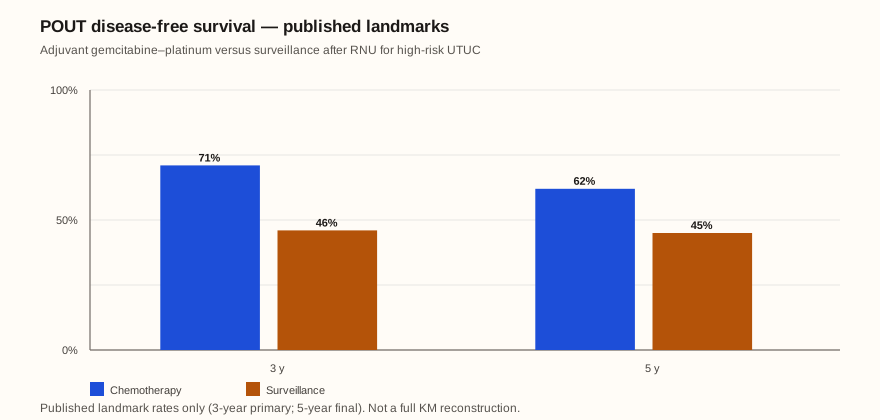
Published DFS landmarks only: 3-year 71% vs 46% (primary); 5-year 62% vs 45% (final); not a full KM reconstruction12.
Landmark evidence
| Trial | Population | Intervention | Comparator | Primary endpoint | Clinically meaningful outcomes | Generalizability-critical differences |
|---|---|---|---|---|---|---|
| POUT primary analysis, N=261 | Post-RNU pT2–T4 and/or pN+ M0 UTUC, fit for platinum1 | Gemcitabine plus cisplatin or protocol-defined carboplatin ×41 | Surveillance1 | Disease-free survival1 | Three-year DFS 71% vs 46%; HR 0.45 (0.30–0.68)1. | Open-label; platinum choice was renal-function defined, not randomized1. |
| POUT final report | Same population2 | Gemcitabine–platinum ×42 | Surveillance2 | Disease-free survival2 | Five-year DFS 62% vs 45%; HR 0.55 (0.38–0.80)2. Five-year OS 66% vs 57%; univariable HR 0.68, while adjusted OS HR 0.76 (0.51–1.12)2. | The OS result is an updated univariable signal, not a definitive adjusted OS benefit2. |
| CheckMate 274 | All high-risk MIUC after radical resection46 | Nivolumab for 1 year46 | Placebo46 | Disease-free survival46 | Grade ≥3 treatment-related AEs 17.9% vs 7.2%46. | All-MIUC trial; do not report an unverified UTUC subgroup efficacy estimate46. |
Biomarkers
| Marker | Current clinic role | Emerging / investigational | How it changes decision now | Limits |
|---|---|---|---|---|
| pT / pN | POUT treatment selection for adjuvant gemcitabine–platinum1 | — | Confirms who is inside the pivotal postoperative population1. | Confirm postoperative imaging when required for nodal disease1. |
| Renal function / GFR | Protocol platinum choice (cisplatin if GFR ≥50; carboplatin if 30–49)1 | — | Selects gemcitabine–cisplatin vs gemcitabine–carboplatin within POUT rules1. | POUT GFR thresholds are trial-specific, not a universal cisplatin eligibility definition1. |
| PD-L1 | Not a substitute for UTUC-specific adjuvant IO evidence46 | Exploratory in all-MIUC adjuvant ICI trials46 | Does not establish a UTUC-only nivolumab/pembrolizumab standard46. | Do not assign an unreported UTUC subgroup effect46. |
| FGFR / HER2 | Not adjuvant selectors after RNU46 | Metastatic biomarker-directed therapy if recurrence46 | No change to adjuvant platinum vs surveillance choice on this page14. | Metastatic-context assays only; not used to select adjuvant chemotherapy14. |
| ctDNA | Not standard for adjuvant selection after RNU4 | Investigational MRD correlatives in urothelial disease4 | Do not withhold or add adjuvant therapy based on ctDNA outside a protocol4. | No practice-ready adjuvant assay on this page4. |
Upcoming research
Field direction: UTUC-specific adjuvant systemic research remains thin; all-MIUC adjuvant IO trials (for example AMBASSADOR) inform counseling but do not create a UTUC-only standard46.
No care-changing prospective UTUC-specific result was identified in the retrieved source pack46. AMBASSADOR is peer-reviewed all-MIUC evidence and does not establish a UTUC-specific standard46.
Toxicity
| Regimen and comparator | Trial-level safety outcomes | Selected named toxicities | Counseling focus |
|---|---|---|---|
| Gemcitabine–platinum versus surveillance, POUT | Acute grade ≥3 treatment-emergent events: 44% vs 4% with surveillance; no treatment-related deaths1. | Chemotherapy-arm named events (treatment-arm rates; surveillance-arm named-event % not retained here): grade ≥3 neutrophil decrease 36%, platelet decrease 10%, nausea 6%, febrile neutropenia 6%, vomiting 6%1. | Contact oncology urgently for fever, infection symptoms, bleeding, uncontrolled vomiting, or dehydration; monitor blood counts and renal function1. |
| Nivolumab versus placebo, CheckMate 274 all MIUC | Grade ≥3 treatment-related events 17.9% vs 7.2%46. | Pruritus 23.1%, fatigue 17.4%, diarrhea 16.8%; grade ≥3 lipase elevation 5.1%; all are all-MIUC, not UTUC-specific46. | Promptly report diarrhea, abdominal pain, cough/dyspnea, rash, fatigue, jaundice, or endocrine symptoms; immune effects can require hold, steroids, or hormone replacement46. |
On-treatment monitoring
| SOC/option regimen | Hallmark monitoring toxicity and published rate | Patient action / clinic response |
|---|---|---|
| Gemcitabine–cisplatin or gemcitabine–carboplatin | POUT chemotherapy-arm named events (treatment-arm rates): grade ≥3 neutrophil decrease 36%, platelet decrease 10%, nausea 6%, febrile neutropenia 6%, and vomiting 6%; trial-level grade ≥3 events 44% vs 4% with surveillance1. | Check CBC, renal function, electrolytes, neuropathy/hearing, and nausea/vomiting; fever, infection symptoms, bleeding, reduced urine output, new hearing change, or uncontrolled vomiting needs urgent assessment1. |
| Single postoperative intravesical chemotherapy | A comparable named adverse-event rate was not retrieved in this systemic-adjuvant source set34. | Review dysuria, hematuria, fever, and urinary symptoms after instillation; fever or escalating urinary symptoms requires prompt contact34. |
| Nivolumab when platinum is unsuitable | CheckMate 274 all-MIUC: grade ≥3 treatment-related events 17.9% vs 7.2%; pruritus 23.1%, fatigue 17.4%, diarrhea 16.8%46. | Review bowel, lung, liver, skin, and endocrine symptoms before each dose; persistent diarrhea/abdominal pain, cough/dyspnea, jaundice, or marked fatigue needs prompt contact46. |
Epic phrase
#utucadjuvant
- Counseling: POUT adjuvant gemcitabine–platinum after RNU: 3-year disease-free survival about 71 in 100 vs 46 in 100 with surveillance (HR 0.45 vs surveillance); 5-year DFS about 62% vs 45% with surveillance (HR 0.55 vs surveillance). Five-year OS 66% vs 57% with surveillance; adjusted OS HR 0.76 vs surveillance (CI crossed 1)—DFS is the established benefit. Nivolumab adjuvant data are from all-MIUC CheckMate 274 versus placebo, not a verified UTUC subgroup estimate.
- Counseling: Reviewed surveillance and de-escalation: four adjuvant gemcitabine–platinum cycles then stop; CT chest/abdomen/pelvis and cystoscopy every 6 months ×2 years then annually (POUT methods for cystoscopy; EAU CT framework); single postoperative intravesical chemotherapy when indicated; metastatic recurrence → systemic pathway.
- Counseling: Reviewed sequence: post-RNU → four cycles of gemcitabine–platinum; use cisplatin at POUT GFR ≥50 and carboplatin at GFR 30–49. Single intravesical chemotherapy is a separate bladder-recurrence intervention; nivolumab for platinum-ineligible disease requires an explicit all-MIUC evidence discussion. ***
- Monitoring: With gemcitabine–platinum, check CBC, renal function, electrolytes, neuropathy/hearing, and nausea/vomiting. With nivolumab, review bowel, lung, liver, skin, and endocrine symptoms; after intravesical treatment, review fever, worsening urinary symptoms, dysuria, and hematuria. Contact oncology urgently for fever, infection symptoms, bleeding, uncontrolled vomiting, dehydration, or concerning immune symptoms. ***
- Decision: *** selects adjuvant gemcitabine–platinum / surveillance / further recovery or trial assessment.
- Labs/NGS: CBC, CMP, renal function *, pathology stage *, postoperative imaging ***.
- Procedures: *** intravesical recurrence-prevention discussion and multidisciplinary review.
- Follow-up: *** treatment monitoring, cystoscopic/bladder surveillance, and imaging.
Guideline references
- EAU UTUC guideline
- AUA/SUO non-metastatic UTUC guideline
- NCCN Bladder and Upper GU Tract Tumors
- ESMO bladder cancer guideline
Sources
- Birtle et al. (2020). POUT primary analysis. *Lancet*. PMID: 32145825
- Birtle et al. (2024). POUT final results. *Journal of Clinical Oncology*. PMID: 38350047
- Coleman et al. (2023). AUA/SUO UTUC guideline. *Journal of Urology*. PMID: 37096584
- EAU UTUC guideline
- AUA/SUO non-metastatic UTUC guideline
- NCCN Bladder and Upper GU Tract Tumors
- ESMO bladder cancer guideline
Changelog
- 2026-09-22: Added explicit POUT/EAU cystoscopy every 6 months ×2 years then annually alongside CT; inserted POUT DFS landmark figure; expanded Biomarkers to five-column table; mirrored cystoscopy + CT cadence in paired dotphrase.
- 2026-09-22: Renamed Upcoming trial results to Upcoming research; reframed for ongoing trials and field direction.
- 2026-09-22: Named surveillance comparator in POUT toxicity/monitoring counseling rates; mirrored comparator-named efficacy counseling in the paired dotphrase.
- 2026-09-22: Added line-level source superscripts ([^n]) linked to numbered Sources.
- 2026-09-22: Added Surveillance and treatment de-escalation section; strengthened quantified benefit counseling in dotphrase.
- 2026-09-21: Added post-RNU therapy sequencing and all-option on-treatment monitoring, retaining the all-MIUC boundary for nivolumab.
- 2026-09-21: Created post-nephroureterectomy UTUC page with POUT eligibility, outcomes, and trial-first toxicity counseling.