Home / GU oncology / Bladder / urothelial / Adjuvant urothelial
Bladder / urothelial → Adjuvant urothelial
clinic-ready — perioperative EV+pembro and NIAGARA now change who still needs classic adjuvant IO; ctDNA MRD selects adjuvant atezo
Evidence page
Who this applies to
- Post-cystectomy (or appropriately selected post-nephroureterectomy) with high-risk pathologic features (CheckMate 274: ypT2–T4a and/or ypN+ after neoadjuvant cisplatin, or pT3–T4a and/or pN+ without neoadjuvant chemo — exact eligibility in the protocol/label; restage from source if needed)1.
- Note neoadjuvant / perioperative exposure: prior EV+pembro or durvalumab changes adjuvant counseling (overlap, cumulative neuropathy, irAE)34.
- Cisplatin eligibility, residual disease, margins, histology/variant, surgical recovery, and ctDNA MRD status if considering IMvigor011-path atezolizumab56.
Standard options
| Clinical context | Option | Key inclusion | Typical duration |
|---|---|---|---|
| High-risk disease after radical surgery without perioperative ICI | Nivolumab or observation1 | CheckMate 274-type risk and recovery1. | One year in trial1. |
| High-risk disease after radical surgery | Pembrolizumab or observation2 | AMBASSADOR DFS evidence; OS was not reported in the retrieved abstract2. | One year in trial2. |
| Post-cystectomy ctDNA MRD-positive disease | Atezolizumab pathway5 | IMvigor011/FDA companion-diagnostic setting5. | Up to one year in trial5. |
| Prior perioperative ICI/ADC or outside evidence | Individualize surveillance or trial34 | Avoid untested second adjuvant ICI sequencing35. | Individualized5. |
- If perioperative EV+pembro or NIAGARA already given or planned as the MIBC pathway: adjuvant counseling is part of that perioperative package, not a separate CheckMate 274 default34.
- If high-risk after RC and no prior perioperative ICI: adjuvant nivolumab 240 mg q2wk ×1 year (CheckMate 274) vs observation vs trial1. AMBASSADOR pembrolizumab 200 mg q3wk ×1 year is DFS-positive; OS not in the retrieved abstract2.
- If post-cystectomy ctDNA MRD+ by Signatera CDx (serial testing window per label): adjuvant atezolizumab (IMvigor011 / FDA 15 May 2026) — distinct from the negative unselected IMvigor010 trial5.
- Do not use adjuvant atezolizumab based on IMvigor010 (unselected high-risk)5.
- Observation remains reasonable when risk is lower, recovery is poor, ctDNA remains negative, or irAE risk is prohibitive56.
- Upper-tract: CheckMate 274 enrolled MIUC including UTUC; do not invent UTUC-specific HRs — not separately reported in the retrieved abstracts1.
Therapy sequencing
| Prior treatment or postoperative state | Next treatment order | Branch point / evidence boundary |
|---|---|---|
| Resectable MIBC selected for EV-303/EV-304 | Neoadjuvant EV plus pembrolizumab → cystectomy → protocol-defined adjuvant EV plus pembrolizumab4. | This is one perioperative package; do not add separate adjuvant nivolumab by default after prior perioperative ICI/EV41. |
| Cisplatin-eligible MIBC selected for NIAGARA | Neoadjuvant durvalumab plus GC → cystectomy → adjuvant durvalumab3. | NIAGARA likewise tests one perioperative package, not subsequent adjuvant-ICI switching3. |
| High-risk disease after radical surgery without perioperative ICI | Adjuvant nivolumab or observation; pembrolizumab is a DFS-positive alternative in AMBASSADOR12. | Choose after recovery and immune-risk assessment; the trials do not establish serial PD-1/PD-L1 therapy12. |
| ctDNA MRD-positive after cystectomy | Atezolizumab up to one year in the IMvigor011/FDA companion-diagnostic pathway5. | This is distinct from unselected IMvigor010, which was negative5. |
| High-risk residual disease after perioperative EV plus pembrolizumab or NIAGARA | Surveillance or clinical trial discussion34. | A preferred salvage-adjuvant sequence is not established in the retrieved sources35. |
Surveillance and treatment de-escalation
Post-cystectomy imaging schedule (EAU practice framework)
| Time after cystectomy | Chest/abdomen/pelvis CT (incl. upper tract when indicated)6 | Notes6 |
|---|---|---|
| Every 6 months through 36 months6 | CT6 | Panel framework; intensify upper-tract monitoring if multifocal disease, CIS, or positive ureteral margins6 |
| Annually thereafter through ~60 months6 | CT6 | Consider stopping routine CT after 5 years in majority of patients without ongoing high-risk features6 |
| Phase | Monitoring cadence | Stop, hold, or de-escalate | Re-escalation / next line |
|---|---|---|---|
| Adjuvant nivolumab or pembrolizumab ×1 year | Labs and immune-symptom review each cycle; ctDNA serial testing if using IMvigor011 pathway125. | Complete 1-year adjuvant course unless grade ≥3/4 immune toxicity; hold for immune events per label12. ctDNA-negative patients should not receive unselected adjuvant atezolizumab (IMvigor010 negative)5. | ctDNA conversion or radiographic recurrence → systemic therapy; avoid untested second adjuvant ICI after perioperative EV/pembro or NIAGARA345. |
| ctDNA MRD-positive adjuvant atezolizumab | ctDNA per companion-diagnostic schedule; immune monitoring5. | Stop at 1 year or progression; hold for immune toxicity5. | Progression → mUC systemic options56. |
- Prior perioperative EV plus pembrolizumab or NIAGARA completes the intended adjuvant component; separate CheckMate 274-style adjuvant ICI is not the default34.
- Observation remains reasonable when risk is lower, recovery is poor, or prior perioperative ICI makes adjuvant PD-1 inappropriate; imaging follows the EAU schedule above156.
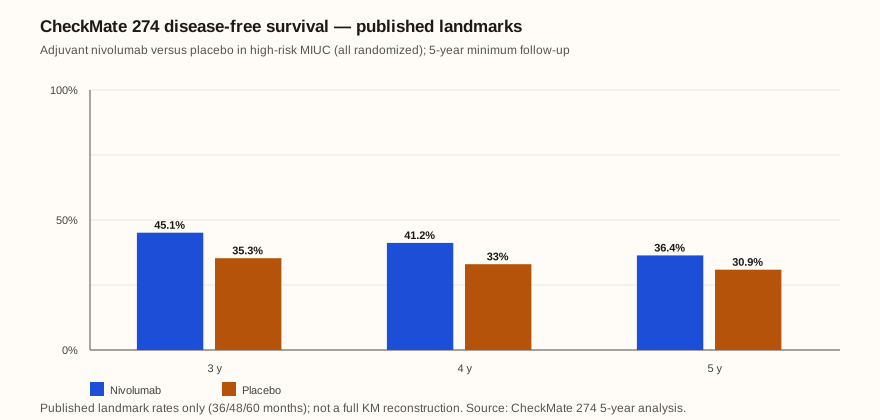
Published DFS landmarks only at 36, 48, and 60 months (nivolumab 45.1%, 41.2%, 36.4% vs placebo 35.3%, 33.0%, 30.9%); not a full KM reconstruction8.
Landmark evidence
These rows mix perioperative (changes adjuvant need) and true adjuvant trials. Indirect comparison only5.
| Trial | Population | Intervention arm | Control arm | Key outcomes (both arms) | Key HR | Evidence status |
|---|---|---|---|---|---|---|
| EV-303 / KEYNOTE-905 NCT03924895 | Cisplatin-ineligible or declined MIBC; RC+PLND candidates; N=3444 | Neoadjuvant EV 1.25 mg/kg d1,8 + pembro 200 mg q3wk ×3 → RC+PLND → adjuvant EV ×6 + pembro (17 total pembro cycles)4 | RC+PLND alone4 | 2-y EFS 74.7% vs 39.4%; 2-y OS 79.7% vs 63.1%; pCR 57.1% vs 8.6%; grade ≥3 AE 71.3% vs 45.9%4 | EFS HR 0.40 (0.28–0.57); OS HR 0.50 (0.33–0.74)4 | Vulsteke 2026 NEJM; FDA Padcev label cisplatin-ineligible4 |
| EV-304 / KEYNOTE-B15 NCT04700124 | Cisplatin-eligible MIBC; N=8084 | Neoadjuvant EV 1.25 mg/kg d1,8 + pembro 200 mg ×4 → RC+PLND → adjuvant EV ×5 + pembro ×134 | Neoadjuvant cisplatin 70 mg/m² d1 + gemcitabine 1000 mg/m² d1,8 ×4 → RC4 | Median EFS NR vs 48.5 mo; 2-y EFS 79.4% vs 66.2%; 2-y OS 86.9% vs 81.3%; pCR 55.8% vs 32.5%; grade ≥3 AE 75.7% vs 67.2%4 | EFS HR 0.53 (0.41–0.70); OS HR 0.65 (0.48–0.89)4 | FDA Padcev label / EV-304 labeled perioperative use4 |
| NIAGARA NCT03732677 | Cisplatin-eligible MIBC; N=533 vs 5303 | Neoadjuvant durvalumab + GC q3wk ×4 → RC → adjuvant durvalumab q4wk ×83 | Neoadjuvant GC ×4 → RC (no adjuvant)3 | 24-mo EFS 67.8% vs 59.8%; 24-mo OS 82.2% vs 75.2%; TRAE grade 3–4 40.6% vs 40.9%; RC 88.0% vs 83.2%. pCR % not in NEJM abstract; FDA summary: pCR not statistically different3 | EFS HR 0.68 (0.56–0.82); OS HR 0.75 (0.59–0.93)3 | Powles 2024 NEJM PMID 392829103 |
| CheckMate 274 | High-risk MIUC after radical surgery; N=7091 | Adjuvant nivo 240 mg q2wk ×1 y1 | Placebo ×1 y1 | Primary median DFS 20.8 vs 10.8 mo1. At ≥5-y minimum follow-up: median DFS 21.9 vs 11.0 mo (not a 5-y DFS %); DFS landmarks 45.1%/41.2%/36.4% vs 35.3%/33.0%/30.9% at 36/48/60 mo; median OS 75.0 vs 50.1 mo8. | DFS HR 0.70 (98.22% CI 0.55–0.90) primary1; 5-y DFS HR 0.74 (0.61–0.90); OS HR 0.83 (0.67–1.02)8 | Bajorin 2021 NEJM PMID 340776431; Galsky 2026 Ann Oncol PMID 411106948 |
| AMBASSADOR A031501 NCT03244384 | High-risk MIUC after radical surgery; N=7022 | Adjuvant pembro 200 mg q3wk ×1 y2 | Observation2 | Median DFS 29.6 vs 14.2 mo; grade ≥3 AE 50.6% vs 31.6%. OS not in abstract2 | DFS HR 0.73 (0.59–0.90)2 | 2025 NEJM PMID 392829022 |
| IMvigor010 NCT02450331 | High-risk MIUC after radical surgery; N=8095 | Adjuvant atezolizumab 1200 mg q3wk ×16 / 1 y5 | Observation5 | Primary DFS not met. Both-arm DFS medians not in retrieved abstract5 | DFS HR not in retrieved abstract5 | Unselected; do not use — guideline/practice boundary5 |
| IMvigor011 NCT04660344 | Post-cystectomy MIBC with ctDNA MRD+ (serial); N=250 (2:1)5 | Atezolizumab 1680 mg q4wk ≤12 cycles / 1 y5 | Placebo5 | Median DFS 9.9 vs 4.8 mo; median OS 32.8 vs 21.1 mo5 | DFS HR 0.64 (0.47–0.87); OS HR 0.59 (0.39–0.90)5 | FDA 15 May 2026; companion Signatera CDx — practice framing per guideline5 |
Biomarkers
| Marker | Current clinic role | Emerging / investigational | How it changes decision now | Limits |
|---|---|---|---|---|
| PD-L1 | Not required for CheckMate 274 ITT DFS benefit1 | Larger DFS effect in PD-L1 ≥1% subgroup (primary DFS HR 0.55; 5-y DFS HR 0.58)18 | Do not withhold nivolumab solely for PD-L1-negative disease based on ITT1. | Subgroup enrichment is not a registration selector for adjuvant nivolumab18. |
| ctDNA MRD (Signatera) | Companion diagnostic selecting adjuvant atezolizumab after cystectomy (IMvigor011 / FDA)5 | CheckMate 274 5-year exploratory baseline ctDNA correlates with recurrence risk8 | Serial testing until positive or end of the recommended 12-month window selects the atezolizumab pathway5. | Exploratory CheckMate 274 ctDNA is not the registration companion for nivolumab18. |
| Nectin-4 | Not an adjuvant IO selector in these trials15 | Perioperative EV plus pembrolizumab context on neoadjuvant/mUC pages4 | No change to classic adjuvant IO choice on this page15. | Not used to select adjuvant nivolumab, pembrolizumab, or atezolizumab15. |
| HER2 | Not an adjuvant IO selector15 | Metastatic / tumor-agnostic HER2 context elsewhere5 | No adjuvant decision change on this page15. | No validated adjuvant assay role here15. |
| FGFR | Not an adjuvant IO selector15 | Metastatic FGFR3 / erdafitinib pathway5 | No adjuvant decision change on this page15. | Adjuvant setting does not use FGFR to select IO15. |
Upcoming research
Field direction: perioperative EV plus pembrolizumab and NIAGARA are reshaping who still needs classic adjuvant IO, while ctDNA MRD (IMvigor011) adds a biomarker branch; residual disease after perioperative therapy and dual EV/IO then MRD-positive pathways remain open questions345.
| Program or question | Why it may change care | Evidence status |
|---|---|---|
| AMBASSADOR overall survival | Clarifies whether adjuvant pembrolizumab DFS benefit translates to mature OS versus observation2. | Peer-reviewed DFS report; OS follow-up pending in this pack2. |
| High-risk yp residual disease after perioperative EV plus pembrolizumab or NIAGARA | Defines adjuvant or next systemic options when pathologic residual disease persists34. | Not answered in retrieved sources; treat as a care-changing evidence gap34. |
| Perioperative EV plus pembrolizumab then later ctDNA MRD positivity | Sequencing when both pathways apply45. | Not defined in retrieved sources45. |
Toxicity
| Regimen and comparator | Trial-level safety outcomes | Counseling focus |
|---|---|---|
| Nivolumab versus placebo, CheckMate 274 | Grade ≥3 treatment-related AEs 17.9% vs 7.2%1. | Promptly report cough/dyspnea, diarrhea, abdominal pain, rash, jaundice, fatigue, or endocrine symptoms; immune toxicity may require a hold, corticosteroids, or hormone replacement1. |
| Pembrolizumab versus observation, AMBASSADOR | Grade ≥3 AEs 50.6% vs 31.6%2. | Use the same immune-toxicity counseling; coordinate with recovery after radical surgery2. |
| Perioperative EV plus pembrolizumab | Grade ≥3 AEs 71.3% vs 45.9% in EV-303 and 75.7% vs 67.2% in EV-3044. | Report rash, neuropathy, visual symptoms, thirst/polyuria, or immune symptoms promptly4. |
| Perioperative durvalumab plus GC | Grade 3–4 treatment-related AEs 40.6% vs 40.9% in NIAGARA3. | Review fever/infection, cytopenias, renal and neuropathy symptoms, and immune toxicity3. |
On-treatment monitoring
| SOC/option regimen | Hallmark monitoring toxicity and available rate | Patient action / clinic response |
|---|---|---|
| Nivolumab, pembrolizumab, or atezolizumab adjuvant pathway | CheckMate 274 nivolumab: grade ≥3 treatment-related AEs 17.9% vs 7.2% with placebo1. AMBASSADOR pembrolizumab: grade ≥3 AEs 50.6% vs 31.6% with observation2. A comparable IMvigor011 named immune-event rate was not retrieved5. | Before each dose, review bowel, lung, liver, thyroid/adrenal, and skin symptoms. Persistent diarrhea/abdominal pain, cough/dyspnea, jaundice, marked fatigue, or palpitations needs prompt contact; immune events may require holding treatment, corticosteroids, or lasting hormone replacement12. |
| Perioperative EV plus pembrolizumab | EV-303 FDA-label treatment-arm rates (single-arm label rates; no paired comparator % in the retained label table): rash 54%, grade 3–4 7%; neuropathy 39%, grade 3–4 3%; increased glucose 72%, grade 3–4 12%4. EV-304: rash 63%, grade 3–4 12%; neuropathy 43%, grade 3–4 3%; hyperglycemia 20%, grade 3–4 7%4. Trial-level grade ≥3 AEs 71.3% vs 45.9% with RC+PLND alone (EV-303) and 75.7% vs 67.2% with neoadjuvant GC (EV-304)4. | Monitor cumulative neuropathy, glucose symptoms, skin, vision, renal function, and immune toxicity before postoperative doses; new numbness/weakness, thirst/polyuria, rash, vision change, dyspnea, or persistent diarrhea requires prompt assessment4. |
| Perioperative durvalumab plus GC | NIAGARA grade 3–4 treatment-related AEs 40.6% vs 40.9% with neoadjuvant GC alone; a comparable named monitoring rate was not extracted3. | Monitor CBC, renal function, electrolytes, neuropathy/hearing, and immune symptoms; fever, infection symptoms, reduced urine output, dyspnea, or severe diarrhea needs urgent assessment3. |
Epic phrase
#Adjuvant urothelial carcinoma
- Counseling: CheckMate 274 adjuvant nivolumab improved disease-free survival versus placebo in high-risk MIUC (DFS HR 0.70 vs placebo). AMBASSADOR pembrolizumab improved DFS versus observation (HR 0.73 vs observation); overall survival was not reported in the retrieved abstract. IMvigor011 ctDNA MRD-positive adjuvant atezolizumab improved DFS (HR 0.64 vs placebo) and OS (HR 0.59 vs placebo)—distinct from negative unselected IMvigor010. Prior perioperative EV/pembro or NIAGARA changes who still needs separate adjuvant ICI.
- Counseling: Reviewed surveillance and de-escalation: post-cystectomy chest/abdomen/pelvis CT every 6 months through 36 months then annually through ~60 months (EAU framework; intensify upper-tract monitoring if multifocal disease, CIS, or positive ureteral margins); adjuvant PD-1 for up to 1 year then stop unless progression/toxicity; ctDNA-negative patients should not receive unselected adjuvant atezolizumab; recurrence → metastatic urothelial pathway.
- Monitoring: With adjuvant nivolumab, pembrolizumab, or atezolizumab, review new diarrhea/abdominal pain, cough/dyspnea, jaundice, rash, marked fatigue, palpitations, or temperature/weight intolerance before every treatment. With perioperative EV plus pembrolizumab, additionally review numbness/weakness, vision change, thirst/polyuria, and rash; with durvalumab plus GC, monitor CBC, renal function, electrolytes, neuropathy/hearing, and immune symptoms. Promptly contact oncology for these symptoms. *** after-hours/urgent-assessment instructions reviewed.
- Discussed pathology and staging: *** (ypT / pT, N, margins, histology, variant features).
- Discussed perioperative course: neoadjuvant / perioperative * (EV+pembro vs durvalumab+GC vs GC vs none; cycles / response); surgery date *. Discussed that perioperative EV+pembrolizumab is FDA-approved for MIBC cystectomy candidates regardless of cisplatin eligibility (EV-303 cisplatin-ineligible; EV-304 cisplatin-eligible, FDA 10 Jul 2026) and NIAGARA (durvalumab + GC) remains an alternative for cisplatin-eligible patients — these change adjuvant counseling. Adjuvant nivolumab (CheckMate 274) is for high-risk patients who did not already receive perioperative ICI. For post-cystectomy ctDNA MRD+ (Signatera CDx), adjuvant atezolizumab (IMvigor011) is FDA-approved — distinct from negative unselected IMvigor010.
- Discussed sequence: perioperative EV+pembrolizumab or durvalumab+GC already includes its postoperative component; do not layer separate adjuvant nivolumab by default after prior perioperative ICI/ADC. If high-risk after surgery without perioperative ICI, consider adjuvant nivolumab or observation; if ctDNA MRD-positive, use the separate atezolizumab pathway. ***
- Discussed adjuvant options: observation vs adjuvant immunotherapy (nivolumab per CheckMate 274 criteria; pembrolizumab per AMBASSADOR; atezolizumab if ctDNA MRD+) vs other per *** guidelines / trial.
- Eligibility / rationale: * (risk features that drive adjuvant Rx; prior perioperative ICI / ADC: *; ctDNA MRD: ***).
- Discussed prognosis and goals.
- Discussed toxicities of planned adjuvant therapy: ***.
- He / she opts to proceed with ***.
- Labs: CBC, CMP; ***
- Imaging surveillance plan: ***
- Referrals: ***
- Follow-up: ***
Guideline references
- NCCN Bladder Cancer
- EAU Muscle-invasive and metastatic bladder cancer guideline
- ESMO bladder cancer guideline
Sources
- Bajorin et al. (2021). CheckMate 274. *New England Journal of Medicine*. PMID: 34077643
- Apolo et al. (2025). AMBASSADOR. *New England Journal of Medicine*. PMID: 39282902
- Powles et al. (2024). NIAGARA. *New England Journal of Medicine*. PMID: 39282910
- FDA Padcev label, revised 2026
- NCCN Bladder Cancer
- EAU Muscle-invasive and metastatic bladder cancer guideline
- ESMO bladder cancer guideline
- Galsky et al. (2026). CheckMate 274 5-year efficacy and ctDNA. *Annals of Oncology*. PMID: 41110694
Changelog
- 2026-09-22: Replaced surveillance with EAU post-cystectomy CT every 6 months ×3 years then annual through ~60 months; added CheckMate 274 DFS landmark figure and Source #8; clarified median DFS vs landmark % in the landmark table; expanded Biomarkers to five-column table; mirrored EAU cadence in paired dotphrase.
- 2026-09-22: Renamed Upcoming trial results to Upcoming research; reframed for ongoing trials and field direction.
- 2026-09-22: Named placebo/observation/GC/surgery comparators in monitoring rates and labeled EV FDA rates as single-arm; mirrored comparator-named counseling in the paired dotphrase.
- 2026-09-22: Added line-level source superscripts ([^n]) linked to numbered Sources.
- 2026-09-22: Added Surveillance and treatment de-escalation section; strengthened quantified benefit counseling in dotphrase.
- 2026-09-21: Added EV-303 and EV-304 FDA-label neuropathy, glucose, and rash monitoring rates to the perioperative row.
- 2026-09-21: Added treatment sequencing and regimen-level on-treatment monitoring, including the IMvigor011 safety-reporting boundary.
- 2026-09-21: Renamed the prospective-evidence section to Upcoming trial results.
- 2026-09-21: Removed Bottom line; added a compact Guidelines table and disease → setting page framing. No treatment recommendations or trial statistics changed.
- 2026-09-21: filled EV-304 FDA approval (10 Jul 2026 — all MIBC cystectomy candidates); added IMvigor011 / Signatera ctDNA MRD adjuvant atezolizumab (FDA 15 May 2026) and clarified IMvigor010 remains negative for unselected adjuvant atezo
- 2026-09-14: expanded from stub; landscape table includes EV-303, EV-304 (now published), NIAGARA, CheckMate 274 5-year, AMBASSADOR, IMvigor010; perioperative SOC explicitly changes adjuvant counseling
- 2026-09-14: initial stub