Home / GU oncology / Prostate / Early salvage RT post-prostatectomy
Prostate → Early salvage radiotherapy after prostatectomy
current — early salvage radiotherapy is most effective at low PSA; systemic and nodal intensification must match trial risk boundaries
Evidence page
Who this applies to
| Population | Direct-evidence boundary | Not established by the pivotal data |
|---|---|---|
| Detectable or rising PSA after prostatectomy | Confirm PSA trajectory, pathology, testosterone, conventional/PSMA imaging when clinically appropriate, and absence of known metastases45. | Do not treat disparate PSA entry windows as identical populations12. |
| GETUG-AFU 16 population | pT2–4a, pN0/x, rising PSA 0.1–2.0 ng/mL, no clinical disease1. | Node-positive, overt metastatic, or PSA-outside-window disease1. |
| RTOG 9601 population | pT2 margin-positive or pT3, N0, PSA 0.2–4.0 ng/mL2. | An exclusively very-low-PSA population2. |
Standard options
| Clinical context | Option | Key inclusion | Typical duration |
|---|---|---|---|
| Biochemical recurrence after prostatectomy | Early salvage prostate-bed radiotherapy4 | AUA/ASTRO/SUO recommends treatment by PSA ≤0.5 ng/mL and allows consideration below 0.2 ng/mL for high-risk patients4. | Field and dose individualized4. |
| High-risk features with salvage radiotherapy | Add ADT124 | Higher-risk features include PSA ≥0.7 ng/mL, Grade Group 4–5, PSADT ≤6 months, persistent PSA, or seminal-vesicle involvement in guideline framing4. | At least 4–6 months when used; longer duration may be considered for high risk124. |
| Selected nodal-risk disease | Pelvic-node plus prostate-bed radiotherapy with short-course ADT3 | Match the SPPORT population and discuss incremental toxicity3. | SPPORT used 4–6 months ADT3. |
Therapy sequencing
| Recurrence state | Treatment order | Evidence boundary |
|---|---|---|
| Rising or persistent PSA after prostatectomy | Evaluate PSA kinetics, pathology, testosterone, and imaging → early salvage prostate-bed radiotherapy at low PSA4. | Early salvage is not a substitute for metastatic treatment when staging establishes distant disease45. |
| High-risk features with salvage radiotherapy | Add ADT to prostate-bed radiotherapy124. | Duration should match the risk and pivotal trial boundary; GETUG-AFU 16 does not establish long-course ADT for every patient1. |
| Selected nodal-risk disease | Prostate-bed plus pelvic-node radiotherapy with 4–6 months ADT3. | SPPORT is a three-arm trial; it does not isolate a radiation-field effect without ADT3. |
| PET-detected distant disease or progression after salvage | Move to a metastatic systemic-therapy pathway5. | This page does not establish a preferred systemic sequence after salvage radiotherapy5. |
Surveillance and treatment de-escalation
| Phase | Monitoring cadence | Stop, hold, or de-escalate | Re-escalation / next line |
|---|---|---|---|
| Before and during salvage RT4 | PSA, testosterone, and imaging to exclude distant disease; treat at PSA ≤0.5 ng/mL when feasible (≤0.2 ng/mL for high-risk features per society guidance)4. | Complete radiotherapy course; ADT duration matches trial (GETUG-AFU 16: two goserelin injections; RTOG 9601: 24 months bicalutamide; SPPORT: 4–6 months ADT with nodal fields)123. | Progression after salvage → ADT intensification, metastatic systemic therapy, or repeat local assessment45. |
| After salvage RT ± ADT4 | PSA every 3–6 months; monitor ADT side effects and bone health46. | Stop short-course ADT at planned end; long-course bicalutamide completes 24 months unless toxicity123. | Rising PSA with imaging-confirmed metastases → mHSPC/mCRPC pathways5. |
- Pelvic-node radiotherapy plus short ADT (SPPORT) is for selected nodal-risk disease; do not extend nodal fields without trial-consistent indications3.
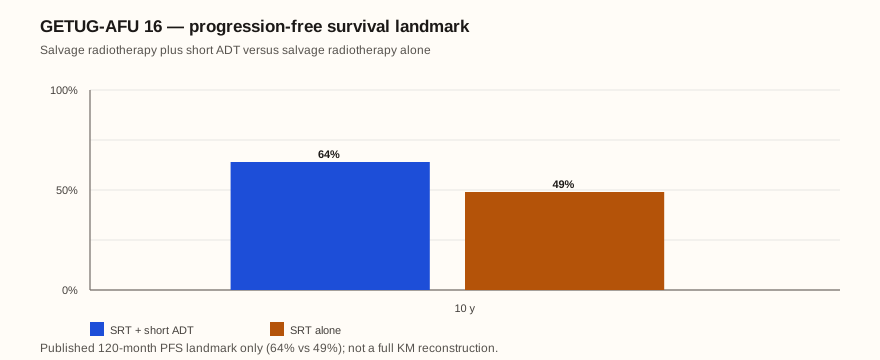
Published 120-month PFS 64% vs 49% (SRT+short ADT vs SRT); not a full KM reconstruction1.
Landmark evidence
| Trial | Population | Intervention | Comparator | Primary endpoint | Clinically meaningful outcomes | Generalizability-critical differences |
|---|---|---|---|---|---|---|
| GETUG-AFU 16 | pT2–4a, pN0/x, PSA 0.1–2.0, no clinical disease1 | Salvage radiotherapy plus two goserelin injections1 | Salvage radiotherapy1 | Progression-free survival1 | 120-month PFS 64% vs 49%; HR 0.54 (0.43–0.68)1. | Short-course ADT study; does not define long-course ADT value1. |
| RTOG 9601 | pT2 margin-positive or pT3, N0, PSA 0.2–4.02 | Salvage radiotherapy plus 24 months bicalutamide2 | Salvage radiotherapy plus placebo2 | Overall survival2 | 12-year OS 76.3% vs 71.3%; HR 0.77 (0.59–0.99)2. | Higher PSA window and 24-month bicalutamide strategy; not an exclusively low-PSA trial2. |
| SPPORT | pT2–3, N0/x, PSA 0.1–2.03 | Pelvic-node plus prostate-bed radiotherapy plus 4–6 months ADT3 | Prostate-bed radiotherapy alone3 | Five-year freedom from progression3 | 87.4% vs 70.9%; intermediate arm with prostate-bed RT plus ADT was 81.3%3. | Three-arm trial; the node-field benefit is not an isolated radiation-only comparison3. |
Biomarkers
| Marker | Current clinic role | Emerging / investigational | How it changes decision now | Limits |
|---|---|---|---|---|
| PSA and PSA doubling time | Defines recurrence kinetics and intensification risk4 | — | Serial PSA guides early salvage timing (treat by ≤0.5 ng/mL when feasible); PSADT ≤6 months is among high-risk features favoring ADT with salvage RT in guideline framing4. | Do not substitute PSA kinetics for staging or a trial entry window124. |
| PSMA PET | Staging and target-definition information45 | Expanding use at low PSA before salvage45 | Helps exclude distant disease and may refine fields when clinically appropriate45. | Negative imaging does not exclude microscopic disease; match treatment to clinical risk and evidence boundary4. |
| Pathology | Risk assessment for ADT and field discussion4 | — | Grade Group, seminal-vesicle involvement, margin, and nodal status inform counseling and intensification4. | Pathology alone does not replace PSA timing or imaging assessment4. |
| Testosterone | Confirms castration status when ADT is used or considered4 | — | Document before and during salvage ± ADT; stop short-course ADT at planned end1234. | Not a selector among salvage-field strategies4. |
Upcoming research
Field direction: PET-directed intensification of salvage radiotherapy and systemic therapy is the main care-changing research track after biochemical recurrence8.
| Trial | Why it may change care | Evidence status |
|---|---|---|
| EA8191 / INDICATE | Tests PET-directed systemic/local intensification against salvage radiotherapy plus short-term ADT after biochemical recurrence8. | Recruiting phase 3; PFS primary endpoint; no outcomes reported8. |
Toxicity
| Regimen and comparator | Trial-level safety outcomes | Selected named toxicities | Counseling focus |
|---|---|---|---|
| Salvage radiotherapy plus goserelin versus radiotherapy, GETUG-AFU 16 | Late grade ≥3 GU events: 7% vs 8%1. | Grade ≥2 hot flushes 8% vs none; sexual disorders 8% vs 5%1. | Counsel on hot flashes, sexual effects, urinary symptoms, and treatment-related fatigue1. |
| Salvage radiotherapy plus bicalutamide versus radiotherapy, RTOG 9601 | The retrieved source set does not provide a table-wide grade ≥3 rate2. | Gynecomastia 69.7% vs 10.9%2. | Discuss breast symptoms, sexual effects, urinary/bowel toxicity, and prompt review of troublesome effects2. |
| SPPORT intensification, SPPORT | Acute grade ≥2 AEs 18%, 36%, and 44% across the three arms3. | Grade ≥3 event values were not supplied in the retrieved abstract3. | Discuss added acute urinary/bowel effects with pelvic-node treatment and ADT3. |
On-treatment monitoring
| SOC/option regimen | Hallmark monitoring toxicity and published rate | Patient action / clinic response |
|---|---|---|
| Salvage radiotherapy plus goserelin | GETUG-AFU 16: late grade ≥3 GU events 7% vs 8%; grade ≥2 hot flushes 8% vs none1. | Monitor urinary/bowel symptoms, hot flashes, sexual function, fatigue, metabolic and bone effects; urinary retention, heavy bleeding, or severe bowel symptoms needs prompt contact1. |
| Salvage radiotherapy plus bicalutamide | RTOG 9601: gynecomastia 69.7% vs 10.9%2. | Review breast symptoms, sexual effects, urinary/bowel symptoms, and fatigue; troublesome breast pain or swelling, retention, heavy bleeding, or severe bowel symptoms needs prompt contact2. |
| Prostate-bed plus pelvic-node radiotherapy with short-course ADT | SPPORT: acute grade ≥2 AEs 18%, 36%, and 44% across the three arms; the retrieved abstract did not report a comparable grade ≥3 named rate3. | Monitor added acute urinary/bowel symptoms and ADT effects; severe diarrhea, retention, heavy bleeding, or dehydration needs prompt contact3. |
Epic phrase
#postprostatectomysalvage
- Counseling: GETUG-AFU 16 added short ADT to salvage RT: 10-year progression-free survival about 64% vs 49% with RT alone (HR 0.54 vs RT alone). RTOG 9601: 12-year overall survival 76.3% with 24 months bicalutamide vs 71.3% with placebo (HR 0.77 vs placebo). SPPORT pelvic-node RT plus short ADT: 5-year freedom from progression 87.4% vs 70.9% with prostate-bed RT alone. Early treatment at low PSA improves outcomes.
- Counseling: Reviewed surveillance and de-escalation: treat at low PSA (≤0.5 ng/mL when feasible); complete planned short or long ADT per trial boundary; post-salvage PSA every 3–6 months; imaging-confirmed metastases → systemic pathway. GETUG-AFU 16 published 120-month PFS about 64% vs 49% with RT alone when short ADT was added (not a full KM curve).
- Counseling: Reviewed sequence: evaluate PSA kinetics/pathology/testosterone/imaging → early salvage prostate-bed radiotherapy; add ADT for high-risk features; use pelvic-node treatment with short-course ADT for the selected SPPORT-like population; metastatic disease moves to a systemic pathway. ***
- Monitoring: Review hot flashes, breast symptoms with bicalutamide, urinary/bowel effects, fatigue, sexual effects, and bone/metabolic effects with ADT. Contact oncology or radiation oncology for urinary retention, heavy bleeding, severe bowel symptoms, or intolerable treatment effects.
- Decision: *** selects prostate-bed salvage radiotherapy / salvage radiotherapy plus ADT / pelvic-node plus prostate-bed radiotherapy with ADT / further staging or trial evaluation.
- Labs/NGS: PSA *, testosterone *, pathology *; PSMA PET *.
- Procedures: *** radiation-oncology and multidisciplinary review.
- Follow-up: *** PSA response, ADT toxicity, urinary/bowel symptoms, and imaging plan.
Guideline references
- AUA/ASTRO/SUO Salvage Therapy guideline
- NCCN Prostate Cancer
- EAU Prostate Cancer treatment guideline
- ESMO local and locoregional prostate cancer guideline
Sources
- Carrie et al. (2019). GETUG-AFU 16. *Lancet Oncology*. PMID: 31629656
- Shipley et al. (2017). RTOG 9601. *New England Journal of Medicine*. PMID: 28146658
- Pollack et al. (2022). SPPORT. *Lancet*. PMID: 35569466
- AUA/ASTRO/SUO Salvage Therapy guideline
- NCCN Prostate Cancer
- EAU Prostate Cancer treatment guideline
- ESMO local and locoregional prostate cancer guideline
- EA8191 / INDICATE
Changelog
- 2026-09-22: Inserted GETUG-AFU 16 120-month PFS landmark figure; expanded Biomarkers to five-column clinic/emerging format (PSA/PSADT, PSMA PET, pathology, testosterone).
- 2026-09-22: Renamed Upcoming trial results to Upcoming research; reframed for ongoing trials and field direction.
- 2026-09-22: Named comparator arms in paired dotphrase counseling for efficacy/toxicity rates.
- 2026-09-22: Added line-level source superscripts ([^n]) linked to numbered Sources.
- 2026-09-22: Added Surveillance and treatment de-escalation section; strengthened quantified benefit counseling in dotphrase.
- 2026-09-21: Added early-salvage sequencing and radiotherapy/ADT monitoring tables.
- 2026-09-21: Created early-salvage radiotherapy page with source-verified intensification evidence and toxicity counseling.