Home / GU oncology / Testis / Stage I GCT
Testis → Clinical stage I germ-cell tumor
current — surveillance is preferred when reliable follow-up is feasible; adjuvant treatment reduces relapse but does not establish a survival advantage over surveillance
Evidence page
Who this applies to
| Population | Definition | Boundary |
|---|---|---|
| Clinical stage I seminoma | Pure seminoma after orchiectomy, normalizing markers, and no metastasis on conventional staging45. | Elevated AFP should be managed as nonseminoma/mixed GCT, not pure seminoma4. |
| Clinical stage I NSGCT | Negative conventional staging with normalized post-orchiectomy markers45. | Persistently rising AFP or hCG is occult systemic disease, not a surveillance/adjuvant population4. |
| Shared requirements | Fertility preservation, contralateral testis assessment, pathology review, and follow-up feasibility45. | IGCCCG prognosis groups apply to metastatic disease, not stage I4. |
Standard options
| Clinical context | Option | Key inclusion | Typical course |
|---|---|---|---|
| Stage I seminoma | Surveillance24 | Feasible cross-sectional imaging and marker follow-up24. | Guideline-directed surveillance46. |
| Stage I seminoma selecting adjuvant therapy | One carboplatin AUC 7 cycle1 | Recurrence-reduction option after shared decision-making14. | One cycle1. |
| Stage I NSGCT, especially LVI-positive or surveillance unsuitable | One BEP cycle3 | LVI is the best-validated relapse risk factor4. | One cycle3. |
| Highly selected stage I NSGCT | Primary nerve-sparing RPLND34 | Specialist-center surgery; consider contraindication to chemotherapy or teratoma with somatic-type malignancy45. | Procedure plus structured surveillance4. |
Therapy sequencing
| Post-orchiectomy setting | Treatment order | Evidence boundary |
|---|---|---|
| Stage I seminoma with reliable follow-up | Surveillance24. | Adjuvant carboplatin reduces relapse but does not establish a survival advantage over surveillance14. |
| Stage I seminoma selecting relapse reduction | One carboplatin AUC 7 cycle → structured surveillance1. | TE19 compares carboplatin with radiotherapy, not surveillance1. |
| Stage I NSGCT, especially LVI-positive or surveillance unsuitable | One BEP cycle → structured surveillance3. | The cited randomized trial compares one BEP cycle with RPLND, not either approach with surveillance3. |
| Highly selected NSGCT | Primary nerve-sparing RPLND → structured surveillance or pathology-directed management34. | Center expertise and pathology matter; do not apply an RPLND strategy to seminoma4. |
Surveillance and treatment de-escalation
#### Seminoma CS I (surveillance or after adjuvant carboplatin/RT)4
| Modality | Year 1 | Year 2 | Year 3 | Years 4–5 | After 5 years |
|---|---|---|---|---|---|
| Tumour markers ± visit4 | 2× | 2× | 2× | 1× | Survivorship plan4 |
| Chest X-ray4 | — | — | — | — | — |
| Abdominopelvic MRI/CT4 | 2× | 2× | Once at 36 mo | Once at 60 mo | — |
#### NSGCT CS I on active surveillance4
| Modality | Year 1 | Year 2 | Year 3 | Years 4–5 | After 5 years |
|---|---|---|---|---|---|
| Tumour markers ± visit4 | 4× (minority suggest 6× if LVI+)4 | 4× | 2× | 1–2× | Survivorship plan4 |
| Chest X-ray4 | 2× | 2× | Once if LVI+ | At 60 mo if LVI+ | — |
| Abdominopelvic MRI/CT4 | 2× | At 24 mo (+18 mo if LVI+ per majority)4 | Once at 36 mo | Once at 60 mo | — |
| Phase | Stop, hold, or de-escalate | Re-escalation / next line |
|---|---|---|
| Surveillance (preferred when feasible)24 | No further adjuvant treatment after orchiectomy when surveillance selected4. | Marker rise or imaging relapse → BEP or EP per metastatic/stage II pathway; refer to germ-cell center46. |
| One-cycle adjuvant (carboplatin or BEP)13 | Single adjuvant cycle completes treatment; do not extend without relapse13. Markers and imaging per EAU post-adjuvant schedules above4. | Relapse → standard metastatic GCT chemotherapy per IGCCCG group4. |
- Adjuvant carboplatin or one BEP reduces relapse but does not establish survival benefit over surveillance in the cited trials13.
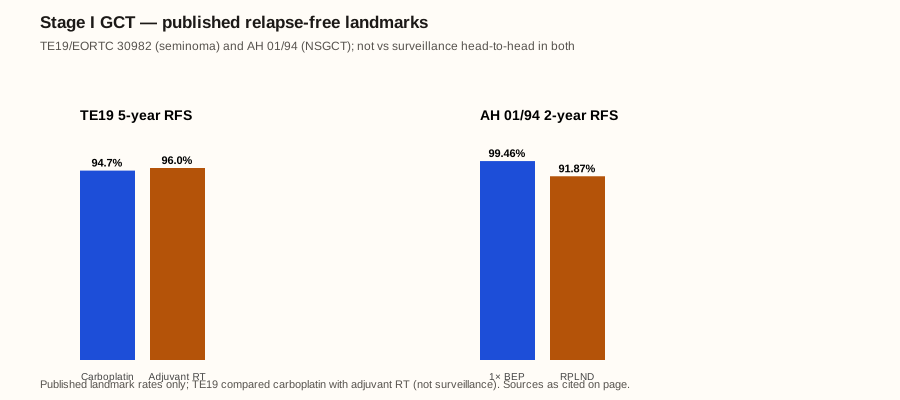
Published landmark relapse-free rates only (TE19 5-year RFS; AH 01/94 2-year RFS); not full KM reconstructions; TE19 compared carboplatin with adjuvant RT, not surveillance13.
Landmark evidence
| Trial | Population | Intervention | Comparator | Primary endpoint | Clinically meaningful outcomes | Generalizability-critical differences |
|---|---|---|---|---|---|---|
| TE19/EORTC 30982, N=1,447 | Unselected stage I seminoma1 | Carboplatin AUC 71 | Adjuvant radiotherapy1 | Relapse-free rate1 | Five-year relapse-free rate 94.7% vs 96.0%; HR 1.25 (90% CI 0.83–1.89)1. | Does not compare carboplatin with surveillance or prove survival benefit1. |
| TRISST, N=669 | Stage I seminoma, normal AFP/hCG, no planned adjuvant therapy2 | MRI surveillance or reduced scan schedule2 | CT surveillance or standard scan schedule2 | Advanced relapse2 | Six-year advanced relapse 0.6% MRI vs 2.6% CT; five-year OS ≥98% in every arm2. | Imaging/surveillance trial, not adjuvant-treatment comparison2. |
| AH 01/94, N=382 | Unselected stage I NSGCT3 | One BEP cycle3 | RPLND3 | Two-year recurrence-free survival3 | 99.46% vs 91.87%3. | Does not compare either strategy with surveillance; RPLND outcomes vary by center expertise3. |
Biomarkers
| Marker | Current clinic role | Emerging / investigational | How it changes decision now | Limits |
|---|---|---|---|---|
| Lymphovascular invasion (NSGCT) | Best-validated relapse-risk factor for stage I NSGCT4 | — | Favors shared discussion of one BEP vs surveillance when LVI+; EAU estimates relapse about 15% without LVI and up to 50% with LVI34. | Shared decision, not a survival mandate for adjuvant therapy4. |
| Tumor size / rete testis invasion (seminoma) | Prognostic discussion only5 | — | May inform counseling intensity; do not use as a stand-alone management rule5. | AUA advises against stand-alone management based on these features5. |
| AFP, hCG, LDH | Staging confirmation and surveillance follow-up4 | — | Persistently rising AFP/hCG after orchiectomy is occult systemic disease, not a stage I surveillance/adjuvant population; elevated AFP rules out pure seminoma4. | Pre-orchiectomy values alone do not define metastatic IGCCCG groups4. |
| miR-371a-3p | Not standard for surveillance decisions89 | MAGESTIC and observational cohorts testing relapse detection89 | Do not replace imaging or standard markers outside a study89. | Not practice-ready as a treatment-selection assay on this page89. |
Upcoming research
Field direction: miR-371 assays are the main surveillance research track that could change relapse detection and adjuvant decision timing in stage I disease89.
| Trial or publication | Why it may change care | Evidence status |
|---|---|---|
| MAGESTIC | Tests miR-371 in stage I surveillance and suspected regional disease8. | Recruiting phase 2; no treatment-changing outcomes8. |
| Belge et al. | Prospective observational miR-371 surveillance cohort may inform future relapse detection9. | Peer-reviewed observational report; not a treatment-selection standard9. |
Toxicity
| Regimen and comparator | Trial-level safety outcomes | Selected named toxicities | Counseling focus |
|---|---|---|---|
| One BEP versus RPLND, long-term AH 01/94 questionnaire | Selected follow-up questionnaire data, not a contemporary regimen-wide estimate3. | Peripheral neuropathy 16% vs 12%; retrograde ejaculation 9% vs 24%3. | Discuss neuropathy, hearing/renal and pulmonary risks from chemotherapy, and ejaculation/fertility effects from surgery; preserve fertility before treatment34. |
| Carboplatin or modern adjuvant radiotherapy for stage I seminoma | No eligible primary-paper named-event table >5% was retrieved1. | Do not add unverified rates1. | Counsel qualitatively on acute treatment effects; radiotherapy has later second-malignancy concern and long-term single-carboplatin safety data remain less mature14. |
On-treatment monitoring
| SOC/option regimen | Hallmark monitoring toxicity and available rate | Patient action / clinic response |
|---|---|---|
| One carboplatin AUC 7 cycle | A comparable named-event rate was not retrieved from the eligible primary paper1. | Check CBC and renal function and review fever/infection symptoms, bruising/bleeding, nausea/vomiting, and new hearing/neuropathy symptoms; fever, bleeding, or uncontrolled vomiting needs prompt contact14. |
| One BEP cycle | AH 01/94 follow-up questionnaire: peripheral neuropathy 16% vs 12% after RPLND; this is long-term selected follow-up, not a contemporary regimen-wide rate3. | Check CBC, renal function, hearing, neuropathy, pulmonary symptoms, and fertility plan; fever, dyspnea, new/worsening numbness, reduced urine output, or severe vomiting needs prompt contact3. |
| Primary nerve-sparing RPLND | AH 01/94: retrograde ejaculation 24% vs 9% after one BEP cycle3. | Review urinary, sexual/ejaculatory, fertility, wound, and thrombotic symptoms; fever, wound concerns, urinary retention, or severe pain needs prompt contact3. |
| Adjuvant radiotherapy, when selected | A comparable named-event rate was not retrieved from the eligible primary paper1. | Review acute bowel, fatigue, and skin symptoms and late survivorship concerns; persistent vomiting, dehydration, severe bowel symptoms, or bleeding needs prompt contact14. |
Epic phrase
#stage1gct
- Counseling: Surveillance is preferred when follow-up is reliable. One carboplatin cycle (TE19): 5-year relapse-free rate about 95% vs 96% with radiotherapy—not versus surveillance; does not prove survival benefit. One BEP vs RPLND (AH 01/94): 2-year recurrence-free survival about 99% vs 92%—does not compare either to surveillance. TRISST: MRI surveillance low advanced-relapse rates with ≥98% 5-year OS in all arms.
- Counseling: Reviewed surveillance and de-escalation: EAU minimal follow-up—seminoma CS I: markers about twice yearly years 1–3 then yearly years 4–5, abdominopelvic MRI/CT twice yearly years 1–2 then at 36 and 60 months (no routine chest X-ray); NSGCT on surveillance: markers about 4×/year years 1–2 (some use 6× if LVI+), chest X-ray twice yearly years 1–2 (± later if LVI+), abdominopelvic MRI/CT twice in year 1, at 24 months (±18 months if LVI+), then at 36 and 60 months. One adjuvant carboplatin or BEP cycle completes treatment without maintenance; marker rise or imaging relapse → metastatic GCT pathway at a germ-cell center.
- Counseling: Reviewed sequence: after orchiectomy, surveillance when feasible; one carboplatin cycle then surveillance for seminoma selecting relapse reduction; one BEP cycle then surveillance for higher-risk NSGCT; or selected nerve-sparing RPLND then structured surveillance. ***
- Monitoring: With carboplatin or BEP, check CBC/renal function and review fever, bleeding, nausea/vomiting, hearing, neuropathy, and pulmonary symptoms; after RPLND, review wound, urinary, sexual/ejaculatory, fertility, and thrombotic symptoms. ***
- Decision: *** selects surveillance / one carboplatin cycle / one BEP cycle / primary RPLND / referral to germ-cell specialist.
- Labs/NGS: AFP, hCG, LDH *; post-orchiectomy trend *; staging imaging ***.
- Procedures: *** sperm banking, pathology review, RPLND consultation.
- Follow-up: *** guideline-directed marker, imaging, and survivorship surveillance.
Guideline references
- EAU Testicular Cancer guideline
- AUA Early-Stage Testicular Cancer guideline
- NCCN Testicular Cancer
- ESMO–EURACAN guideline
Sources
- Oliver et al. (2011). TE19/EORTC 30982. *Journal of Clinical Oncology*. PMID: 21282539
- Joffe et al. (2022). TRISST. *Journal of Clinical Oncology*.
- Albers et al. (2008). AH 01/94. *Journal of Clinical Oncology*. PMID: 18458040
- EAU Testicular Cancer guideline
- AUA Early-Stage Testicular Cancer guideline
- NCCN Testicular Cancer
- ESMO–EURACAN guideline
- MAGESTIC
- Belge et al. (2023). miR-371 surveillance cohort. PMID: 37967143
Changelog
- 2026-09-22: Replaced vague surveillance with EAU minimal follow-up tables for seminoma and NSGCT CS I; added published RFS landmark figure; expanded Biomarkers to five-column table; mirrored marker/imaging cadence in paired dotphrase.
- 2026-09-22: Renamed Upcoming trial results to Upcoming research; reframed for ongoing trials and field direction.
- 2026-09-22: Named comparator arms in paired dotphrase counseling for efficacy/toxicity rates.
- 2026-09-22: Added line-level source superscripts ([^n]) linked to numbered Sources.
- 2026-09-22: Added Surveillance and treatment de-escalation section; strengthened quantified benefit counseling in dotphrase.
- 2026-09-21: Added stage-I treatment sequencing and monitoring tables for surveillance alternatives, chemotherapy, radiotherapy, and RPLND.
- 2026-09-21: Created stage I seminoma and NSGCT reference with explicit surveillance, adjuvant, and fertility boundaries.