Home / GU oncology / Prostate / Localized high-risk
Prostate → Localized high-risk
current — local therapy is the foundation; systemic intensification evidence applies to a defined very-high-risk/cN1 population
Evidence page
Who this applies to
| Population | Direct-evidence boundary | Not established by the pivotal data |
|---|---|---|
| High-risk or locally advanced, nonmetastatic prostate cancer | Confirm clinical stage, PSA, Grade Group, conventional staging, life expectancy, urinary function, and treatment priorities34. | Do not equate a guideline high-risk label with every trial population12. |
| STAMPEDE-like high-risk M0 disease | Conventional-imaging M0, WHO performance status 0–2, and cN1 or cN0 with at least two of cT3–4, Gleason 8–10, and PSA ≥40 ng/mL2. | The abiraterone result should not be extrapolated to every high-risk patient2. |
Standard options
| Clinical context | Option | Key inclusion | Typical duration |
|---|---|---|---|
| Localized high-risk disease | Radical prostatectomy within planned multimodality care34 | Surgical fitness and a plan for pathology-directed postoperative management34. | Procedure plus risk-adapted follow-up3. |
| Locally advanced or high-risk disease selecting radiation | Definitive radiotherapy plus long-course ADT1 | Localized/locally advanced disease; integrate urinary, bowel, bone, metabolic, and cardiovascular risks1. | EORTC 22961 compared 6 months with 3 years of androgen suppression1. |
| STAMPEDE-like very-high-risk or cN1 M0 disease receiving ADT plus radiotherapy | Add abiraterone plus prednisolone2 | Exact STAMPEDE high-risk M0 eligibility required2. | ADT 3 years plus abiraterone/prednisolone 2 years in the trial2. |
Therapy sequencing
| Starting point | Treatment order | Evidence boundary |
|---|---|---|
| Localized high-risk disease selecting surgery | Radical prostatectomy → pathology- and PSA-directed postoperative surveillance or salvage pathway34. | Do not use the radiotherapy/ADT trials to prescribe postoperative treatment without the surgical pathology and PSA context12. |
| Locally advanced or high-risk disease selecting radiation | Definitive radiotherapy plus long-course ADT1. | EORTC 22961 compares androgen-suppression duration after radiotherapy; it does not select a surgical versus radiation approach1. |
| STAMPEDE-like very-high-risk/cN1 M0 disease | ADT plus radiotherapy → add two years of abiraterone/prednisolone while ADT continues for the trial duration2. | This sequence requires the exact STAMPEDE-like risk boundary; it is not evidence for every high-risk localized patient2. |
| Biochemical persistence or recurrence after surgery | Move to the early-salvage radiotherapy pathway46. | The next decision depends on PSA kinetics, imaging, and pathology rather than routine adjuvant therapy for all46. |
Surveillance and treatment de-escalation
| Setting | PSA | Imaging | Stop/de-escalate | Re-escalate |
|---|---|---|---|---|
| After radical prostatectomy35 | Every 3–6 months for 5 years, then annually35. | Pathology-directed imaging only for symptoms or rising PSA35. | No routine adjuvant radiotherapy for undetectable PSA in the modern-trial population46. | Biochemical persistence/recurrence → early salvage radiotherapy pathway46. |
| After definitive radiotherapy plus ADT12 | Every 6 months12. | As clinically indicated for symptoms or rising PSA; ADT duration per EORTC 22961 (3 years total androgen suppression after initial 6 months) or protocol STAMPEDE (abiraterone 2 years with 3 years ADT)12. | Complete planned ADT/abiraterone duration unless toxicity mandates hold; taper or stop ADT only after shared decision at planned end12. | PSA rise after local therapy → salvage options, systemic intensification, or mHSPC pathway if metastatic35. |
| STAMPEDE-like intensification2 | Per post-RT cadence above; also monitor blood pressure, potassium, and LFTs on abiraterone/prednisolone2. | Same as post-RT setting2. | Stop abiraterone at 2 years per trial; continue ADT to 3 years2. | Metastatic progression → mHSPC page23. |
- EAU/NCCN recommend risk-adapted PSA surveillance after local therapy; imaging for symptomatic or high-rate PSA rise35.
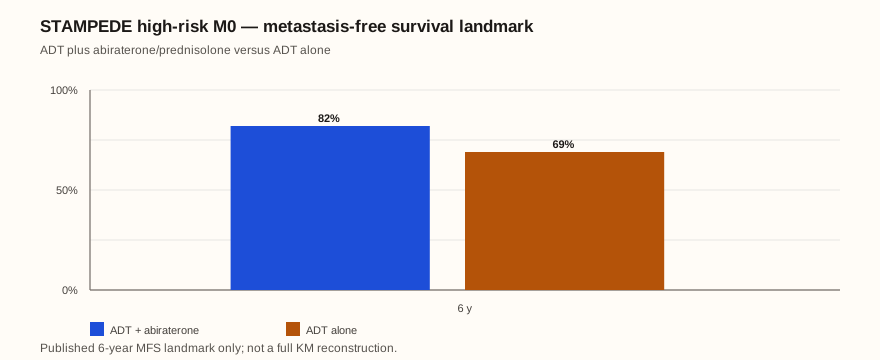
Published 6-year MFS 82% vs 69% (ADT+abiraterone vs ADT); not a full KM reconstruction2.
Landmark evidence
| Trial | Population | Intervention | Comparator | Primary endpoint | Clinically meaningful outcomes | Generalizability-critical differences |
|---|---|---|---|---|---|---|
| EORTC 22961, N=970 | Locally advanced disease after radiotherapy plus 6 months androgen suppression1 | Continue androgen suppression for 2.5 more years1 | Stop androgen suppression1 | Overall survival1 | Five-year mortality 15.2% with long-course versus 19.0% with short-course suppression; short-course HR for death 1.421. | Directly tests duration after radiotherapy, not surgery or abiraterone intensification1. |
| STAMPEDE, N=1,974 | High-risk nonmetastatic disease on ADT; radiotherapy planned/required by protocol context2 | ADT plus abiraterone/prednisolone2 | ADT alone2 | Metastasis-free survival2 | Six-year MFS 82% vs 69%; MFS HR 0.53. OS HR 0.602. | Very-high-risk/cN1 eligibility; not a comparison of local-treatment modalities2. |
Biomarkers
| Marker | Current clinic role | Emerging / investigational | How it changes decision now | Limits |
|---|---|---|---|---|
| Grade Group, PSA, clinical stage, and conventional imaging | Risk and local-therapy selection34 | — | Define clinical risk and confirm STAMPEDE-like eligibility before intensification123. | Do not equate a guideline high-risk label with every trial population12. |
| Decipher | Not a standard local-therapy selector7 | NRG-GU009 is testing Decipher-directed ADT duration with radiotherapy7 | Do not substitute it for trial eligibility outside a protocol7. | No efficacy results yet; investigational for ADT-duration tailoring in this setting7. |
| Germline BRCA / HRR | Hereditary-risk counseling and later-line planning3 | Broader HRR panels when indicated3 | Informs genetic counseling; does not select surgery vs radiotherapy or STAMPEDE abiraterone on this page3. | Not a local-therapy selector in the source pack3. |
| PSMA PET | Staging information when clinically appropriate35 | Expanding use for biochemical recurrence staging35 | May refine staging before intensifying systemic therapy or salvage pathways35. | Does not replace conventional staging for applying STAMPEDE-like eligibility as written on this page23. |
| MSI / TMB | Later-line immunotherapy consideration only3 | Expanding tumor-agnostic use3 | Does not select local therapy or ADT intensification in localized high-risk disease3. | Not a local-therapy selector; relevant if metastatic progression leads to later-line options3. |
Upcoming research
Field direction: genomic risk–adapted ADT duration and ARPI intensification with radiotherapy are the main care-changing experiments in localized high-risk disease7.
| Trial | Why it may change care | Evidence status |
|---|---|---|
| NRG-GU009 / PREDICT-RT | Tests Decipher-directed ADT duration and apalutamide intensification with radiotherapy in high-risk disease7. | Phase 3, active not recruiting; MFS primary endpoint; no efficacy results7. |
Toxicity
| Regimen and comparator | Trial-level safety outcomes | Selected named toxicities | Counseling focus |
|---|---|---|---|
| ADT plus abiraterone/prednisolone versus ADT, STAMPEDE | Grade ≥3 AEs: 37% vs 29%2. | Grade ≥3 hypertension 5% vs 1%; grade ≥3/4 ALT elevation 6% vs <1%2. | Monitor blood pressure and hepatic tests; promptly report severe headache, chest symptoms, jaundice, or marked fatigue2. |
| Radiotherapy plus androgen suppression, EORTC 22961 | The retrieved abstract does not supply a comparable numerical toxicity table1. | Do not add unverified named-event percentages1. | Counsel on urinary/bowel change, sexual function, hot flashes, fatigue, bone loss, metabolic and cardiovascular effects1. |
On-treatment monitoring
| SOC/option regimen | Hallmark monitoring toxicity and available rate | Patient action / clinic response |
|---|---|---|
| Long-course ADT with definitive radiotherapy | The retrieved EORTC 22961 abstract did not supply a comparable named-event table1. | Monitor urinary/bowel symptoms during radiotherapy, sexual function, hot flashes, fatigue, bone density, metabolic parameters, and cardiovascular risk; urinary retention, heavy bleeding, or severe bowel symptoms needs prompt contact1. |
| ADT plus abiraterone/prednisolone with radiotherapy | STAMPEDE: grade ≥3 hypertension 5% vs 1% and grade ≥3/4 ALT elevation 6% vs <1%2. | Check blood pressure, potassium, liver tests, edema, and corticosteroid effects; severe headache, chest symptoms, weakness, jaundice, or edema needs prompt contact2. |
Epic phrase
#localizedhighriskprostate
- Counseling: For radiotherapy plus long-course ADT, EORTC 22961 showed lower 5-year mortality with 3 years vs 6 months of androgen suppression after radiotherapy. In STAMPEDE-like very-high-risk M0 disease, 6-year metastasis-free survival was about 82% vs 69% with ADT alone (MFS HR 0.53 vs ADT alone; OS HR 0.60 vs ADT alone) when abiraterone was added to ADT. These results apply to defined trial populations, not every high-risk localized patient.
- Counseling: Reviewed surveillance and de-escalation: after RP, PSA every 3–6 months for 5 years then annually (imaging for symptoms or rising PSA); after RT+ADT, PSA every 6 months with ADT duration per EORTC/STAMPEDE; complete planned ADT (and 2 years abiraterone if STAMPEDE-like); biochemical recurrence after surgery → early salvage RT pathway; metastatic progression → mHSPC page. STAMPEDE published 6-year MFS about 82% vs 69% with ADT alone when abiraterone was added (not a full KM curve).
- Counseling: Reviewed sequence: surgery → PSA/pathology-directed surveillance or salvage pathway; or definitive radiotherapy plus long-course ADT, with abiraterone/prednisolone only for the defined STAMPEDE-like very-high-risk/cN1 population. ***
- Monitoring: During radiotherapy plus ADT, review urinary/bowel symptoms, sexual function, hot flashes, fatigue, bone, metabolic, and cardiovascular effects. With abiraterone/prednisolone, check blood pressure, potassium, liver tests, and edema. ***
- Counseling: Reviewed that STAMPEDE intensification applies to a defined high-risk nonmetastatic population, not every guideline-defined high-risk patient. For abiraterone, reviewed hypertension and liver-test monitoring; promptly report severe headache, chest symptoms, jaundice, or marked fatigue.
- Decision: *** selects surgery / radiotherapy plus ADT / radiotherapy plus ADT with abiraterone-prednisolone / clinical-trial evaluation.
- Labs/NGS: PSA *, testosterone *, CBC/CMP *; germline testing *; Decipher *** only if it will inform a trial or documented decision.
- Procedures: *** radiation-oncology, urologic-oncology, and multidisciplinary review.
- Medications: *** ADT and supportive bone/metabolic-health plan.
- Follow-up: *** PSA, testosterone, treatment-toxicity, bone-health, and imaging follow-up.
Guideline references
- NCCN Prostate Cancer
- AUA/ASTRO Clinically Localized Prostate Cancer Guideline
- EAU Prostate Cancer treatment guideline
- ESMO local and locoregional prostate cancer guideline
Sources
- Bolla et al. (2009). Duration of androgen suppression in the treatment of prostate cancer. *New England Journal of Medicine*. PMID: 19516032
- Attard et al. (2022). Abiraterone acetate and prednisolone with or without enzalutamide for high-risk non-metastatic prostate cancer. *Lancet*. PMID: 34953525
- NCCN Prostate Cancer
- AUA/ASTRO Clinically Localized Prostate Cancer Guideline
- EAU Prostate Cancer treatment guideline
- ESMO local and locoregional prostate cancer guideline
- NRG-GU009 / PREDICT-RT
Changelog
- 2026-09-22: Explicit Setting×PSA×Imaging surveillance table; inserted STAMPEDE 6-year MFS landmark figure; expanded Biomarkers to five-column clinic/emerging format (including PSMA PET and MSI/TMB limits).
- 2026-09-22: Renamed Upcoming trial results to Upcoming research; reframed for ongoing trials and field direction.
- 2026-09-22: Named comparator arms in paired dotphrase counseling for efficacy/toxicity rates.
- 2026-09-22: Added line-level source superscripts ([^n]) linked to numbered Sources.
- 2026-09-22: Added Surveillance and treatment de-escalation section; strengthened quantified benefit counseling in dotphrase.
- 2026-09-21: Added local-therapy sequencing and all-regimen on-treatment monitoring for ADT, radiotherapy, and abiraterone/prednisolone.
- 2026-09-21: Created localized high-risk prostate setting page with source-verified ADT-duration and STAMPEDE evidence.