Home / GU oncology / Prostate / Adjuvant RT post-prostatectomy
Prostate → Adjuvant radiotherapy after prostatectomy
current — modern trials support surveillance with early salvage radiotherapy for the studied population rather than routine adjuvant radiotherapy
Evidence page
Who this applies to
| Population | Trial criteria or boundary | Decision implication |
|---|---|---|
| Adverse pathology after radical prostatectomy with PSA ≤0.2 ng/mL | RADICALS-RT, RAVES, and GETUG-AFU 17 randomized within roughly 22 weeks after surgery123. | Surveillance and protocol-defined early salvage are the direct modern-trial comparison4. |
| Persistent PSA, pathologic node-positive disease, or known metastatic disease | Outside the modern ART-versus-early-salvage population4. | Use a setting-specific salvage/intensification discussion; do not import this result unchanged46. |
Standard options
| Clinical context | Option | Key inclusion | Typical course |
|---|---|---|---|
| Adverse pathology with undetectable PSA | PSA surveillance with early salvage radiotherapy if indicated4 | Modern ARTISTIC-type population4. | Trigger and field individualized to PSA kinetics, pathology, and imaging46. |
| Selected exceptional postoperative risk | Adjuvant radiotherapy after multidisciplinary discussion56 | Do not treat the randomized evidence as a blanket rule for persistent PSA or pN+ disease4. | Individualized56. |
Therapy sequencing
| Postoperative state | Treatment order | Evidence boundary |
|---|---|---|
| Adverse pathology with undetectable PSA | PSA surveillance → early salvage radiotherapy if recurrence criteria are met4. | This is the modern randomized comparison and does not apply unchanged to persistent PSA or pN+ disease4. |
| Persistent PSA, nodal disease, or imaging-detected recurrence | Enter the early-salvage/intensification pathway rather than routine-adjuvant evidence6. | These states were outside the modern ART-versus-early-salvage trial population4. |
| Exceptional postoperative risk after multidisciplinary review | Consider adjuvant radiotherapy56. | ART is not a blanket sequence; balance recurrence risk against durable urinary and sexual toxicity123. |
Surveillance and treatment de-escalation
| Setting | PSA | Imaging | Stop/de-escalate | Re-escalate |
|---|---|---|---|---|
| Post-prostatectomy surveillance (preferred)46 | Every 3–6 months within the first 2 years, then every 6 months through 5 years; testosterone if ADT ever used567. | As clinically indicated for symptoms or rising PSA; staging before salvage when triggered46. | Do not deliver routine adjuvant radiotherapy when PSA is undetectable in the ARTISTIC population; observation with protocol-defined early salvage is the modern comparison4. | PSA rise above institutional early-salvage trigger → salvage radiotherapy pathway while PSA remains low46. |
| Selected adjuvant radiotherapy15 | Every 3–6 months15. | As clinically indicated; urinary and sexual toxicity assessment alongside PSA15. | Complete planned radiotherapy course; hold only for acute toxicity1. | Biochemical or imaging progression → salvage intensification or systemic therapy56. |
- AUA/ASTRO/SUO support early salvage when PSA rises rather than automatic adjuvant radiotherapy for the studied adverse-pathology, undetectable-PSA population6.
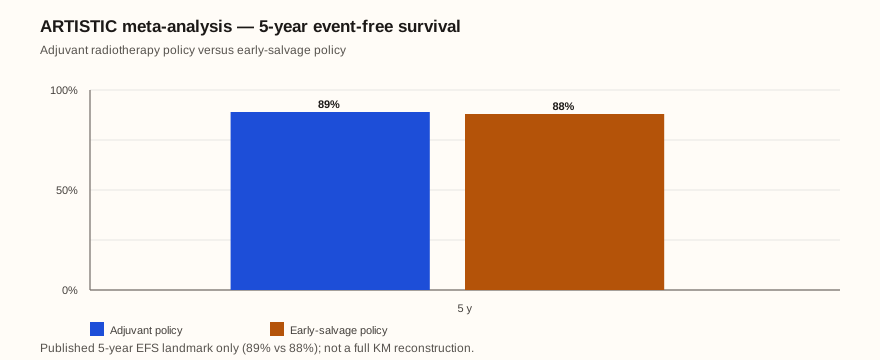
Published 5-year EFS 89% vs 88% (adjuvant vs early-salvage policy); not a full KM reconstruction4.
Landmark evidence
| Trial | Population | Intervention | Comparator | Primary endpoint | Clinically meaningful outcomes | Generalizability-critical differences |
|---|---|---|---|---|---|---|
| RADICALS-RT, N=1,396 | ≥1 adverse feature after prostatectomy1 | Adjuvant prostate-bed radiotherapy1 | Observation with salvage-policy radiotherapy1 | Freedom from distant metastasis1 | Ten-year FFDM 93% vs 90%; HR 0.68 (0.43–1.07); OS HR 0.981. | Includes varied adverse features; not a persistent-PSA strategy1. |
| RAVES, N=333 | Margin positivity, extraprostatic extension, or seminal-vesicle invasion; PSA ≤0.102 | Adjuvant radiotherapy2 | Early salvage radiotherapy2 | Five-year freedom from biochemical progression2 | 86% vs 87%; salvage/adjuvant HR 1.12 (0.65–1.90)2. | Did not meet prespecified noninferiority because events were fewer than expected2. |
| GETUG-AFU 17 | pT3–4a/R1, pN0/x; all received 6 months triptorelin3 | Adjuvant radiotherapy plus triptorelin3 | Early salvage radiotherapy plus triptorelin3 | Event-free survival3 | Five-year EFS 92% vs 90%; HR 0.81 (0.48–1.36)3. | Hormone therapy in both arms; not a radiation-alone comparison3. |
| ARTISTIC, N=2,153 | Meta-analysis of the three modern trials4 | Adjuvant-radiotherapy policy4 | Early-salvage policy4 | Event-free survival4 | Five-year EFS 89% vs 88%; HR 0.95 (0.75–1.21)4. | Only 39% in the early-salvage-policy group had started radiotherapy at analysis4. |
Biomarkers
| Marker | Current clinic role | Emerging / investigational | How it changes decision now | Limits |
|---|---|---|---|---|
| Postoperative PSA | Defines the undetectable-PSA trial boundary124 | — | Undetectable PSA supports observation with early salvage; persistent PSA needs a salvage rather than routine-adjuvant discussion46. | Persistent PSA, pN+, or known metastases were outside the modern ART-versus-early-salvage population4. |
| Pathology (Grade Group, SVI, margins, pN) | Recurrence-risk assessment123 | — | Margin, grade, extracapsular extension, and seminal-vesicle invasion characterize risk and inform salvage timing discussion1234. | These features do not mandate routine ART in the modern-trial population4. |
| PSMA PET | Staging information when PSA rises or salvage is planned56 | Expanding use at low PSA for target definition56 | May refine salvage planning when recurrence is suspected; does not by itself mandate adjuvant RT while PSA is undetectable46. | Not a validated selector for routine adjuvant radiotherapy in the ARTISTIC population4. |
| Germline testing | Hereditary-risk counseling when indicated5 | Broader panels for later-line planning5 | Informs genetic counseling; does not select adjuvant vs early-salvage policy on this page45. | Not an ART-versus-salvage treatment selector in the source pack45. |
Upcoming research
Field direction: PET-M0 node-positive disease with detectable PSA is the main intensification experiment after prostatectomy9.
| Trial | Why it may change care | Evidence status |
|---|---|---|
| NRG-GU008 / INNOVATE | Tests pelvis/prostate-bed radiotherapy plus 24 months hormone therapy with or without apalutamide in PET-M0, pN+ disease with detectable PSA9. | Phase 3, active not recruiting; MFS primary endpoint; no efficacy results9. |
Toxicity
| Regimen and comparator | Trial-level safety outcomes | Selected named toxicities | Counseling focus |
|---|---|---|---|
| Adjuvant versus early-salvage radiotherapy, RADICALS-RT | Grade 3–4 urethral stricture within 2 years: 6% vs 4%1. | One-year urinary incontinence 5.3% vs 2.7%1. | Review urinary leakage, obstruction, hematuria, bowel change, and sexual dysfunction; contact the team for retention or heavy bleeding1. |
| Adjuvant versus early-salvage radiotherapy, RAVES | Grade ≥2 GU toxicity: 70% vs 54%2. | The retrieved abstract does not provide named-event percentages2. | Counsel on urinary and sexual effects and avoid adding unverified event-level rates2. |
| Adjuvant versus early-salvage radiotherapy, GETUG-AFU 17 | Late grade ≥2 GU toxicity: 59% vs 22%3. | Late grade ≥2 erectile dysfunction: 28% vs 8%3. | Discuss durable urinary and erectile effects before choosing treatment timing3. |
On-treatment monitoring
| SOC/option regimen | Hallmark monitoring toxicity and published rate | Patient action / clinic response |
|---|---|---|
| Adjuvant or early-salvage prostate-bed radiotherapy | RADICALS-RT: grade 3–4 urethral stricture within two years 6% vs 4%; one-year urinary incontinence 5.3% vs 2.7%1. | Monitor urinary leakage, obstruction, retention, hematuria, bowel change, and sexual function; retention or heavy bleeding requires prompt contact1. |
| Radiotherapy plus six months of triptorelin in GETUG-AFU 17 | Late grade ≥2 GU toxicity 59% vs 22%; late grade ≥2 erectile dysfunction 28% vs 8%3. | Review urinary, bowel, erectile, hot-flash, fatigue, metabolic, and bone symptoms; retention, heavy bleeding, or severe bowel symptoms needs prompt contact3. |
Epic phrase
#postprostatectomyart
- Counseling: Modern trials (ARTISTIC meta-analysis) showed similar 5-year event-free survival with adjuvant vs early-salvage radiotherapy policy (about 89% vs 88%; HR 0.95 vs early salvage). RADICALS-RT 10-year freedom from distant metastasis 93% vs 90% with early-salvage policy (HR 0.68 vs early salvage, CI crossed 1). Observation with early salvage at low PSA is preferred for undetectable PSA after adverse pathology.
- Counseling: Reviewed surveillance and de-escalation: PSA every 3–6 months within the first 2 years, then every 6 months through 5 years when observing after adverse pathology with undetectable PSA; early salvage RT at low PSA rise rather than routine adjuvant RT for the modern-trial population (ARTISTIC published 5-year EFS about 89% vs 88% for adjuvant vs early-salvage policy; not a full KM curve); persistent PSA or pN+ needs separate intensification discussion.
- Monitoring: During radiotherapy, review urinary leakage/obstruction, retention, hematuria, bowel change, and sexual function; if triptorelin is used, also review hot flashes, fatigue, metabolic, and bone effects. Contact the team for urinary retention, heavy hematuria, or new severe bowel symptoms; late urinary and erectile effects can persist.
- Decision: *** selects PSA surveillance with early salvage planning / adjuvant radiotherapy after multidisciplinary review.
- Labs/NGS: PSA *; postoperative pathology *; genomic classifier *** only if it will inform a documented decision.
- Procedures: *** radiation-oncology consultation and imaging plan.
- Follow-up: *** PSA timing, symptom assessment, and salvage trigger.
Guideline references
- NCCN Prostate Cancer
- AUA/ASTRO/SUO Salvage Therapy guideline
- EAU Prostate Cancer treatment guideline
- ESMO local and locoregional prostate cancer guideline
Sources
- Parker et al. (2024). RADICALS-RT. *Annals of Oncology*. PMID: 38583574
- Kneebone et al. (2020). RAVES. *Lancet Oncology*. PMID: 33002437
- Sargos et al. (2020). GETUG-AFU 17. *Lancet Oncology*. PMID: 33002438
- Vale et al. (2020). ARTISTIC meta-analysis. *Lancet*. PMID: 33002431
- NCCN Prostate Cancer
- AUA/ASTRO/SUO Salvage Therapy guideline
- EAU Prostate Cancer treatment guideline
- ESMO local and locoregional prostate cancer guideline
- NRG-GU008 / INNOVATE
Changelog
- 2026-09-22: Explicit Setting×PSA×Imaging surveillance table; inserted ARTISTIC 5-year EFS landmark figure; expanded Biomarkers to five-column clinic/emerging format.
- 2026-09-22: Renamed Upcoming trial results to Upcoming research; reframed for ongoing trials and field direction.
- 2026-09-22: Named comparator arms in paired dotphrase counseling for efficacy/toxicity rates.
- 2026-09-22: Added line-level source superscripts ([^n]) linked to numbered Sources.
- 2026-09-22: Added Surveillance and treatment de-escalation section; strengthened quantified benefit counseling in dotphrase.
- 2026-09-21: Added postoperative therapy sequencing and radiotherapy/ADT on-treatment monitoring.
- 2026-09-21: Created postoperative adjuvant-radiotherapy setting page with modern adjuvant-versus-early-salvage evidence.