Home / GU oncology / RCC / Adjuvant clear-cell RCC
RCC → Adjuvant clear-cell RCC
current — pembrolizumab has randomized DFS and OS benefit; in the US, pembrolizumab plus belzutifan is FDA-labeled with immature OS
Evidence page
Who this applies to
KEYNOTE-564 eligibility and decision boundary
| Risk group | Exact trial definition | Adjuvant discussion |
|---|---|---|
| Intermediate-high risk | Clear-cell RCC: pT2 grade 4 or sarcomatoid, N0 M0; or pT3 any grade, N0 M01 | Discuss pembrolizumab and risk-adapted surveillance114. |
| High risk | Clear-cell RCC: pT4 any grade, N0 M0; or any pT, any grade, N+ M01 | Discuss pembrolizumab and risk-adapted surveillance114. |
| M1 NED | Primary tumor plus solid, isolated, soft-tissue, nonbone/nonbrain metastasis completely resected with negative margins synchronously or within 1 year after nephrectomy; NED at baseline1 | Discuss in a multidisciplinary setting; the subgroup is small and should not be treated as equivalent to M0 cohorts14. |
| Lower-risk clear-cell RCC | Does not meet a trial risk definition1 | Use risk-adapted surveillance; do not extend the trial result to lower-risk disease114. |
| Non-clear-cell RCC | Outside the KEYNOTE-564 population1 | Do not extrapolate the pembrolizumab result; discuss surveillance or a clinical trial114. |
- KEYNOTE-564 required nephrectomy and, when relevant, metastasectomy within 12 weeks before randomization1. This is trial eligibility, not a universal treatment-start mandate14.
- Confirm histology, pT/pN stage, grade, sarcomatoid features, margin status, surgery date, NED status, recovery, renal function, autoimmune history, and baseline endocrinopathy before deciding114.
Standard options
| Circumstance | Option | Shared-decision discussion | Typical course |
|---|---|---|---|
| KEYNOTE-564–eligible clear-cell RCC | Pembrolizumab1 | Randomized benefit was versus placebo, not surveillance1. Discuss the DFS/OS results, immune-related toxicity, and possibility of overtreatment42. | Trial regimen: 200 mg IV every 3 weeks for up to 17 cycles1. The current US label also permits 400 mg IV every 6 weeks18. |
| US adult with intermediate-high/high-risk clear-cell RCC or qualifying M1 NED | Pembrolizumab plus belzutifan519 | FDA-labeled in the US1819. LITESPARK-022 showed a DFS benefit over pembrolizumab plus placebo (24-month DFS 80.7% vs 73.7%; HR 0.72), but OS was immature and grade ≥3 treatment-emergent AEs were 52.1% vs 30.2% with pembrolizumab plus placebo5. Do not present it as OS-proven or interchangeable with pembrolizumab alone519. | Pembrolizumab 200 mg IV every 3 weeks or 400 mg IV every 6 weeks plus belzutifan 120 mg orally daily; up to 1 year per label1819. |
| Eligible patient preferring no adjuvant systemic therapy, or with competing risk/frailty/major immune-risk concern | Risk-adapted surveillance1415 | Active management option; use postoperative imaging and functional follow-up individualized to recurrence risk, renal function, and preferences1415. | Ongoing14 |
| Non-clear-cell RCC or a patient outside the pivotal population | Clinical trial or risk-adapted surveillance114 | There is no KEYNOTE-564 direct-evidence basis to select pembrolizumab1. | Protocol or ongoing14 |
EAU timing after restaging—not trial eligibility
The EAU RCC guideline strongly recommends offering adjuvant pembrolizumab after restaging, preferably 12–16 weeks after nephrectomy, to patients with KEYNOTE-564-defined risk14. It also directs shared discussion of the discordant adjuvant-ICI trials, overtreatment, and immune-related adverse effects14.
Surveillance and treatment de-escalation
EAU Leibovich-adapted imaging (chest + abdomen CT; abdominal MRI alternative)
| Risk (ccRCC Leibovich 2003) | 3 mo | 6 mo | 12 mo | 18 mo | 24 mo | 30 mo | 36 mo | After year 3 | After year 5 |
|---|---|---|---|---|---|---|---|---|---|
| Low (score 0–2)14 | — | CT | — | CT | — | CT | — | CT every 2 years14 | Consider stopping oncologic imaging based on age/comorbidity/preference14 |
| Intermediate (score 3–5)14 | — | CT | CT | — | CT | — | CT | Annual CT14 | CT every 2 years; consider stopping after year 514 |
| High (score ≥6)14 | CT | CT | CT | CT | CT | — | CT | Annual CT14 | CT every 2 years14 |
| Phase | Labs / on-treatment monitoring | Stop, hold, or de-escalate | Re-escalation / next line |
|---|---|---|---|
| Risk-adapted surveillance (no adjuvant)1415 | Renal function and blood pressure with imaging visits14. | No systemic therapy when outside KEYNOTE-564 eligibility or patient declines114. | Recurrence → metastatic RCC page or metastasectomy discussion for oligometastatic disease1415. |
| Adjuvant pembrolizumab (± belzutifan US label)182 | CBC, CMP, TSH every 3 weeks (or q6wk if q6wk pembro); immune-symptom review each visit182. | Complete up to 17 cycles (pembro) or 1 year per label unless progression or toxicity; hold for grade ≥3 immune events118. Belzutifan continues with pembro for labeled duration; OS immature for combination—shared decision to stop at 1 year519. | Recurrence on or after adjuvant → mRCC page; prior adjuvant PD-1 exposure informs first-line metastatic choice1415. |
- KEYNOTE-564 DFS/OS curves already appear under Landmark evidence (source-recreated); use them when counseling surveillance versus adjuvant pembrolizumab34.
- EAU recommends offering adjuvant pembrolizumab after restaging, preferably 12–16 weeks post-nephrectomy, for KEYNOTE-564-defined risk14.
Landmark evidence
KEYNOTE-564: practice-changing DFS and OS
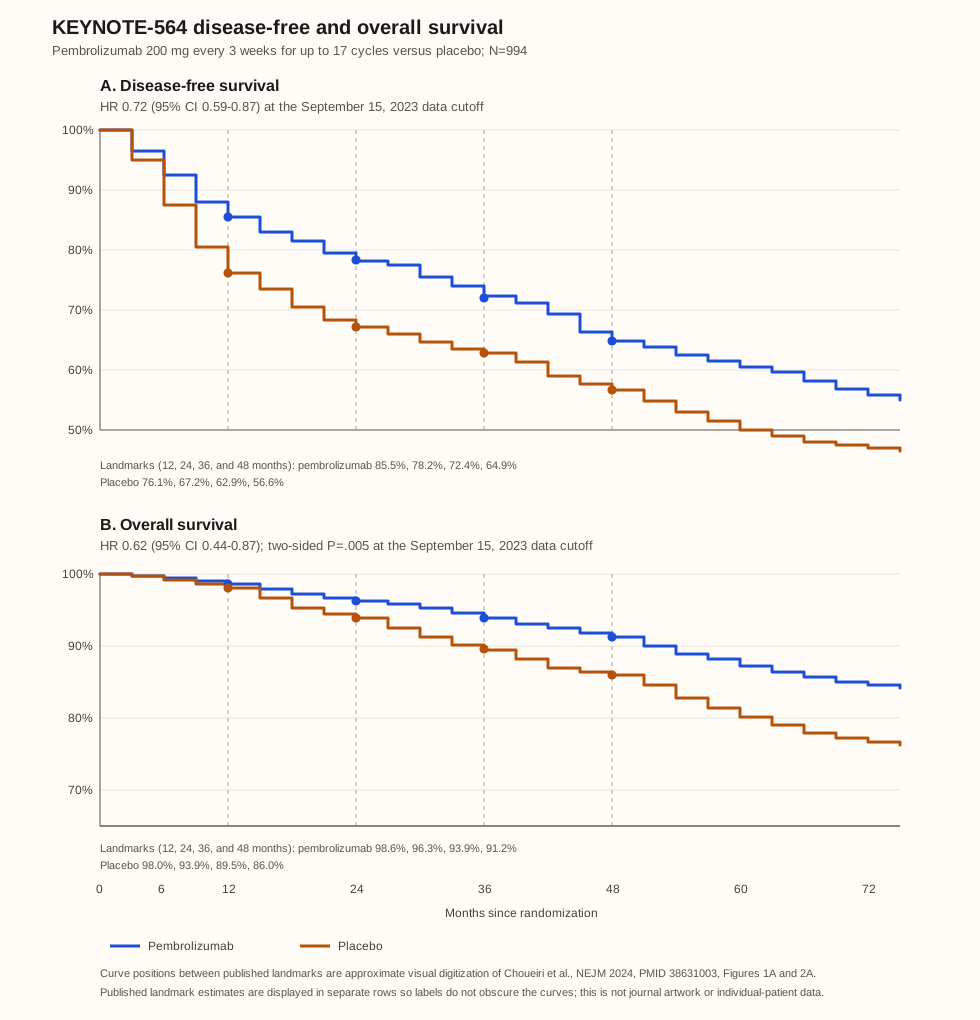
Approximate source-recreated full Kaplan–Meier traces digitized from the published KEYNOTE-564 DFS and OS figures at the September 15, 2023 data cutoff; no journal artwork or individual-patient data are reproduced3. Exact published 12-, 24-, 36-, and 48-month estimates are labeled3. Intermediate curve positions are approximate visual digitization and must not be read as reported landmark estimates3.
Cross-trial comparison
Trial results are not head-to-head efficacy comparisons: eligibility, recurrence risk, M1 NED inclusion, treatment exposure, endpoint assessor, and comparator differ14. Hazard ratios and published landmark rates are reported where available.
| Trial | Population | Intervention | Comparator | Primary endpoint | Clinically meaningful outcomes | Generalizability-critical differences |
|---|---|---|---|---|---|---|
| KEYNOTE-564, NCT03142334 | 994 ccRCC with intermediate-high/high risk or qualifying M1 NED after nephrectomy ± metastasectomy14 | Pembrolizumab 200 mg IV every 3 weeks for ≤17 cycles1 | Matching placebo1 | Investigator-assessed DFS1 | 5-year DFS 60.9% vs 52.2% (HR 0.71)4. 5-year OS 87.7% vs 82.3% (HR 0.66)4. | ccRCC only; includes qualifying M1 NED but not lower-risk disease1. Direct evidence base for adjuvant pembrolizumab14. |
| LITESPARK-022, NCT05239728 | 1,841 ccRCC at increased recurrence risk after nephrectomy5 | Pembrolizumab 400 mg IV every 6 weeks for ≤9 doses + belzutifan 120 mg orally daily5 | Pembrolizumab 400 mg IV every 6 weeks + placebo5 | Investigator-assessed DFS5 | 24-month DFS 80.7% vs 73.7% (HR 0.72)5. OS HR 0.78 (P=.24) at 29% of planned events; immature5. | Add-on trial against pembrolizumab, not pembrolizumab vs surveillance; does not test pembrolizumab monotherapy’s effect versus placebo5. |
| S-TRAC, NCT00375674 | 615 locoregional, high-risk ccRCC after nephrectomy6 | Sunitinib 50 mg orally daily, 4 weeks on/2 weeks off, for 1 year6 | Placebo6 | Blinded independent central review DFS6 | Median DFS 6.8 vs 5.6 years (HR 0.76; P=.03); OS immature6. | Clear-cell, high-risk population; different recurrence-risk definition and VEGFR-TKI mechanism from the ICI trials6. |
| ASSURE, NCT00326898 | 1,943 completely resected nonmetastatic RCC, including clear-cell and non-clear-cell; high-grade pT1b or greater7 | Sunitinib or sorafenib for 54 weeks7 | Placebo7 | DFS for each active arm vs placebo7 | 5-year DFS: sunitinib 54.3%, sorafenib 54.0%, placebo 56.4%; HR 1.02 and 0.97, respectively7. | Only trial here including non-clear-cell RCC and a lower-risk high-grade pT1b threshold; broader population than KEYNOTE-5647. |
| PROTECT, NCT01235962 | 1,538 resected pT2 high-grade or ≥pT3/N1 ccRCC8 | Pazopanib daily for 1 year; starting dose reduced from 800 to 600 mg8 | Placebo8 | DFS in the protocol-amended 600-mg intention-to-treat population8 | Primary DFS HR 0.86 (95% CI 0.70–1.06; P=.165); final OS HR 1.008. | ccRCC only and M0; primary dose/population changed after safety attrition, so the secondary 800-mg DFS signal is not comparable with the primary result8. |
| ATLAS, NCT01599754 | 724 RCC with >50% clear-cell component, ≥pT2 and/or N+, no macroscopic residual/metastatic disease9 | Axitinib 5 mg orally twice daily for ≤3 years9 | Placebo9 | Independent review committee DFS9 | Stopped for futility; DFS HR 0.87 (95% CI 0.66–1.15; P=.32)9. Highest-risk subgroup IRC analysis HR 0.74 (P=.0704)9. | Entry included ≥pT2 disease, potentially lower risk than S-TRAC; highest-risk finding is subgroup evidence, not a positive primary endpoint9. |
| IMmotion010, NCT03024996 | 778 RCC with clear-cell or sarcomatoid component and increased recurrence risk, including an M1 NED stratum10 | Atezolizumab 1,200 mg IV every 3 weeks for 16 cycles10 | Placebo10 | Investigator-assessed DFS10 | Median DFS 57.2 vs 49.5 months (HR 0.93; P=.50)10. | Histology criterion and risk definitions differ from KEYNOTE-564; negative PD-L1 inhibitor trial does not establish a class effect10. |
| CheckMate 914 Part A, NCT03138512 | 816 localized, predominantly ccRCC, M0, after partial/radical nephrectomy 4–12 weeks earlier11 | Nivolumab 240 mg IV every 2 weeks ×12 + ipilimumab 1 mg/kg IV every 6 weeks ×411 | Matching placebo11 | Blinded independent central review DFS11 | 24-month DFS 76% vs 74% (HR 0.92; P=.53)11. Grade 3–5 AEs 38% vs 10%11. | M0 only; excluded active autoimmune disease or substantial immunosuppression, used a shorter course, and did not include M1 NED11. |
| CheckMate 914 Part B, NCT03138512 | Separate 825-participant cohort with the same localized, predominantly ccRCC M0 eligibility13 | Nivolumab 240 mg IV every 2 weeks for ≤12 doses13 | Placebo13 | Blinded independent central review DFS13 | 18-month DFS 78.4% vs 75.4% (HR 0.87; P=.40)13. OS immature13. | Same M0-only and immunosuppression/autoimmunity boundaries as Part A; different regimen duration and no M1 NED13. |
| PROSPER ECOG-ACRIN EA8143, NCT03055013 | 819 previously untreated clinical T2+ or any-N+ RCC, clear-cell or non-clear-cell; selected oligometastatic NED eligible12 | One preoperative nivolumab 480 mg dose → surgery → nine adjuvant doses12 | Surgery followed by observation12 | Investigator-reviewed RFS12 | Stopped for futility; RFS HR 0.94 (95% CI 0.74–1.21; one-sided P=.32)12. | Perioperative, open-label strategy with an observation comparator; includes non-clear-cell and selected oligometastatic disease, so it is not an adjuvant-only placebo comparison12. |
Biomarkers
| Marker | Current clinic role | Emerging / investigational | How it changes decision now | Limits |
|---|---|---|---|---|
| Clear-cell + KEYNOTE-564 risk features | Direct-evidence selection for adjuvant pembrolizumab1 | — | Defines who is inside the pivotal population for adjuvant discussion1. | Confirm on nephrectomy pathology; do not extend benefit claims to non-clear-cell or lower-risk disease1. |
| Leibovich score (2003) | Risk-adapted surveillance imaging intensity (EAU)14 | — | Sets chest/abdomen CT cadence for observation after nephrectomy14. | Prognostic imaging framework only; not a substitute for KEYNOTE-564 adjuvant eligibility114. |
| PD-L1 | Not a routine adjuvant selector114 | Exploratory correlatives in adjuvant ICI trials114 | Does not select who receives adjuvant pembrolizumab114. | No validated threshold for adjuvant benefit114. |
| ctDNA / MRD | Not standard for adjuvant selection14 | MRD GATE RCC testing MRD-guided observation vs pembrolizumab in KEYNOTE-564–eligible ccRCC14 | Do not withhold adjuvant therapy for a negative MRD result outside a trial14. | Assay performance and decision thresholds are not practice-ready on this page14. |
| Tumor genomic / expression signature | Not used to select adjuvant pembrolizumab14 | Investigational molecular classifiers14 | No change to adjuvant or surveillance choice today14. | No validated assay for this setting14. |
| Germline evaluation | Hereditary-risk assessment when age, bilateral/multifocal disease, family history, or syndrome features raise concern1417 | Broader panel testing when indicated1417 | Informs genetic counseling and contralateral/family risk; not adjuvant drug selection1417. | Does not replace KEYNOTE-564 pathology criteria114. |
Upcoming research
Field direction: adjuvant pembrolizumab remains the DFS-proven anchor; intensifying with HIF-2 (LITESPARK-022), broadening ICI platforms (RAMPART), and MRD- or VEGFR-guided strategies (MRD GATE RCC, STRIKE) are the next experiments514115.
| Trial or publication | Why it may change care | Evidence status |
|---|---|---|
| LITESPARK-022 mature follow-up | Clarifies whether the established DFS advantage of pembrolizumab plus belzutifan over pembrolizumab alone becomes an OS advantage and how durable the added toxicity is5. | Peer-reviewed phase 3 publication; OS immature at the reported analysis5. Study follow-up remains active5. |
| RAMPART, NCT03288532 | Tests adjuvant durvalumab alone or with tremelimumab against active monitoring in resected RCC, including non-clear-cell disease; longer follow-up may contextualize the discordant ICI-trial results14. | Phase 3 platform. Enrollment closed in June 2023; congress reporting and OS follow-up are pending peer-reviewed maturity14. |
| MRD GATE RCC, NCT06005818 | Tests whether an MRD-guided strategy can safely observe MRD-negative, otherwise KEYNOTE-564–eligible clear-cell RCC while treating MRD-positive participants with pembrolizumab114. | Recruiting, nonrandomized phase 2; no efficacy results14. |
| STRIKE, NCT06661720 | Phase 3 test of adding tivozanib to adjuvant pembrolizumab for high-risk RCC1415. | Registry-posted trial; no efficacy results14. |
Toxicity
The table preserves regimen-level safety outcomes and limits named-toxicity rows to events reported in more than 5% of patients at any grade; named events with a grade 3 or higher signal are preferred2. LITESPARK-022 evaluates belzutifan added to pembrolizumab, not either regimen against surveillance5.
| Regimen and comparator | Trial-level safety outcomes | Selected named toxicities | Counseling focus |
|---|---|---|---|
| Pembrolizumab versus placebo, KEYNOTE-564 | At 30.1 months, grade ≥3 AEs of any cause: 32% versus 18%; immune-mediated AEs: 36% versus 7%; discontinuation due to AEs: 21% versus 2%2. | Hypothyroidism: 21% versus 4%; hyperthyroidism: 13% versus 0%2. Grade-specific rates for these thyroid events were not reported in the available trial text2. | Check thyroid function and review new fatigue, weight or temperature intolerance, and palpitations218. Immune toxicity can require a treatment hold, systemic corticosteroids, or hormone replacement; endocrine effects can persist218. |
| Pembrolizumab plus belzutifan versus pembrolizumab plus placebo, LITESPARK-022 | Grade ≥3 treatment-emergent AEs: 52.1% versus 30.2%; discontinuation of all study treatment: 11.9% versus 9.0%; immune-mediated AEs or infusion reactions: 35.4% versus 38.7%5. | US label: decreased hemoglobin, 95% with grade 3–4 11% (versus 26% and 0.7%); increased ALT, 57% with grade 3–4 13% (versus 33% and 3.2%); hypoxia, 7% with grade ≥3 5%19. | Monitor CBC, ALT, and oxygen saturation19. Promptly report new fatigue, lightheadedness, or dyspnea; marked breathing difficulty needs urgent assessment19. |
On-treatment monitoring
| SOC/option regimen | Hallmark monitoring toxicity and published rate | Patient action / clinic response |
|---|---|---|
| Pembrolizumab | KEYNOTE-564: immune-mediated AEs 36% vs 7%; hypothyroidism 21% vs 4% and hyperthyroidism 13% vs 0%2. | Check thyroid function and review fatigue, weight or temperature intolerance, palpitations, and other bowel, lung, liver, skin, or endocrine symptoms; persistent diarrhea, dyspnea, jaundice, or marked fatigue requires prompt contact218. |
| Pembrolizumab plus belzutifan | LITESPARK-022 label versus pembrolizumab plus placebo: decreased hemoglobin 95% vs 26%, grade 3–4 11% vs 0.7%; increased ALT 57% vs 33%, grade 3–4 13% vs 3.2%; hypoxia 7% (grade ≥3 5%) in the combination arm—comparator hypoxia rate not reported in the retained label row19. | Monitor CBC, ALT, and oxygen saturation; new fatigue, lightheadedness, or dyspnea needs prompt contact and marked breathing difficulty needs urgent assessment19. |
Patient counseling and action plan
- For pembrolizumab, ask patients to contact the oncology team for new thyroid symptoms, including unexplained fatigue, weight or temperature intolerance, or palpitations218. Immune toxicity can begin during or after treatment and may require a hold, corticosteroids, or hormone replacement; endocrine effects can be lasting218.
- For pembrolizumab plus belzutifan, monitor CBC, ALT, and oxygen saturation19. Ask patients to contact the oncology team for new fatigue, lightheadedness, or shortness of breath; marked breathing difficulty needs urgent assessment19.
- For belzutifan, review the label-specific embryo-fetal warning and pregnancy-prevention counseling19. This clinically critical warning is retained despite not being a numeric trial-toxicity row19.
Epic phrase
#adjuvantccrcc
Phrase helpers
Choose the documented category before copying the phrase.
KEYNOTE-564 eligibility
Uses the published trial definition; it does not determine treatment suitability or timing.
Complete calculator fields
- Counseling: Reviewed pathology-based recurrence risk after nephrectomy with the KEYNOTE-564 eligibility calculator: Not selected. This calculator classifies the published trial-risk category; it does not replace pathology review or patient-specific treatment assessment.
- Counseling: Reviewed adjuvant pembrolizumab and risk-adapted surveillance. In KEYNOTE-564, at 5 years estimated disease-free survival was about 61 in 100 vs 52 in 100 with pembrolizumab versus placebo, and overall survival about 88 in 100 vs 82 in 100 (published 60.9% vs 52.2% DFS; 87.7% vs 82.3% OS). Trial compared pembrolizumab to placebo after surgery, not to surveillance alone. Results apply to the trial population and do not establish benefit in lower-risk or non-clear-cell RCC. US label also permits pembrolizumab plus belzutifan with immature OS versus pembrolizumab alone.
- Counseling: Reviewed surveillance and treatment de-escalation: if observation selected, use EAU Leibovich-adapted chest and abdomen CT—low risk (score 0–2) at about 6, 18, and 30 months then every 2 years with option to stop after year 5; intermediate (3–5) at 6, 12, 24, and 36 months then annually then every 2 years after year 5; high (≥6) more frequent early CT including 3 months, then annual after year 3 and every 2 years after year 5. If adjuvant pembrolizumab (± belzutifan), complete up to the labeled year unless toxicity or progression, then continue Leibovich-adapted imaging. Recurrence → metastatic RCC pathway.
- Counseling: For M1 NED, reviewed that the trial required complete resection of the primary tumor and a solid, isolated soft-tissue metastasis at nephrectomy or within 1 year. The subgroup was small; multidisciplinary review is needed rather than a standalone efficacy estimate.
- Counseling: Reviewed pembrolizumab toxicity in KEYNOTE-564: grade ≥3 AEs of any cause were 32% vs 18% with placebo; 21% vs 2% discontinued because of an AE; immune-mediated AEs occurred in 36% vs 7% with placebo. The named immune toxicities retained for counseling are hypothyroidism (21% vs 4% with placebo) and hyperthyroidism (13% vs 0% with placebo). Some immune effects can occur after treatment and can persist; treatment may require holding therapy, corticosteroids, hormone replacement, or specialist care.
- Counseling: Reviewed when to contact oncology promptly: new unexplained fatigue, weight or temperature intolerance, palpitations, lightheadedness, or shortness of breath. Marked breathing difficulty needs urgent assessment. *** after-hours/urgent-assessment instructions reviewed.
- Monitoring: With pembrolizumab, obtain thyroid testing and review bowel, lung, liver, skin, and endocrine symptoms. With pembrolizumab plus belzutifan, obtain CBC, ALT, and oxygen saturation; new fatigue, lightheadedness, or dyspnea requires prompt contact. ***
- Counseling: If considering pembrolizumab plus belzutifan, reviewed that it is FDA-labeled in the US for eligible clear-cell RCC. LITESPARK-022 showed a DFS benefit versus pembrolizumab plus placebo; overall-survival data were immature. Grade ≥3 treatment-emergent AEs were 52.1% versus 30.2% with pembrolizumab plus placebo. Label-verified safety signals versus pembrolizumab plus placebo are decreased hemoglobin (95% vs 26%; grade 3–4 11% vs 0.7%) and increased ALT (57% vs 33%; grade 3–4 13% vs 3.2%); hypoxia was 7% (grade ≥3 5%) in the combination arm—comparator hypoxia rate was not reported in the retained label row. It is not presented as proven to improve overall survival.
- Decision: *** elects pembrolizumab / pembrolizumab plus belzutifan / risk-adapted surveillance / clinical-trial evaluation after shared decision-making.
- Labs/NGS: Documented KEYNOTE-564 risk assessment: Not selected; confirmed histology * and risk features *. Obtain thyroid testing for pembrolizumab and CBC, ALT, and oxygen saturation for pembrolizumab plus belzutifan per label and institutional protocol. Severe anemia or hypoxia may require a dose hold, reduction, or discontinuation. Review belzutifan pregnancy-prevention counseling per label. Tumor NGS and ctDNA are not required to select adjuvant therapy.
- Procedures: *** postoperative restaging and multidisciplinary review completed / planned. For non-clear-cell histology or disease outside KEYNOTE-564 criteria, favor surveillance or clinical-trial review rather than extrapolating pembrolizumab benefit.
- Medications: If selected, pembrolizumab monotherapy is 200 mg IV every 3 weeks for up to 17 cycles. Pembrolizumab plus belzutifan is pembrolizumab 200 mg IV every 3 weeks or 400 mg IV every 6 weeks plus belzutifan 120 mg orally daily, for up to 1 year; confirm current FDA label and local formulary.
- Referrals: *** medical oncology / endocrinology / nephrology / clinical-trial consultation, as indicated.
- Follow-up: *** risk-adapted chest and abdominal surveillance; review new immune-related symptoms and renal function at each visit.
Guideline references
| Source | Setting-level reference |
|---|---|
| EAU Renal Cell Carcinoma guideline | Strong recommendation to offer adjuvant pembrolizumab after restaging, preferably 12–16 weeks post-nephrectomy, for KEYNOTE-564-defined clear-cell risk; shared decision-making should address overtreatment, immune toxicity, and discordant ICI trials. |
| NCCN Kidney Cancer guideline | Current US professional guideline reference for adjuvant systemic-therapy pathways. |
| ESMO RCC Clinical Practice Guideline | Current European guideline reference for diagnosis, treatment, and follow-up. |
| AUA localized renal mass guideline | US urology reference for localized-RCC management and follow-up. |
| FDA Keytruda label, revised July 2026 | US labeled adjuvant pembrolizumab monotherapy and pembrolizumab–belzutifan indications and dosing. |
Sources
- Choueiri et al. (2021). Adjuvant pembrolizumab after nephrectomy in renal-cell carcinoma. *New England Journal of Medicine*. DOI: 10.1056/NEJMoa2106391 | PMID: 34407342
- Powles et al. (2022). KEYNOTE-564 30-month follow-up. *Lancet Oncology*. DOI: 10.1016/S1470-2045(22)00487-9 | PMID: 36055304
- Choueiri et al. (2024). Overall survival with adjuvant pembrolizumab in renal-cell carcinoma. *New England Journal of Medicine*. DOI: 10.1056/NEJMoa2312695 | PMID: 38631003
- Haas et al. (2026). Five-year KEYNOTE-564 results. *Annals of Oncology*. DOI: 10.1016/j.annonc.2026.08.006 | PMID: 42648402
- Choueiri et al. (2026). Adjuvant pembrolizumab plus belzutifan for renal-cell carcinoma. *New England Journal of Medicine*. DOI: 10.1056/NEJMoa2518245 | PMID: 42384869
- Ravaud et al. (2016). Adjuvant sunitinib in high-risk renal-cell carcinoma after nephrectomy. *New England Journal of Medicine*. DOI: 10.1056/NEJMoa1611406 | PMID: 27718781
- Haas et al. (2016). Adjuvant sunitinib or sorafenib for high-risk, non-metastatic renal-cell carcinoma (ASSURE). *Lancet*. DOI: 10.1016/S0140-6736(16)00559-6 | PMID: 26969090
- Motzer et al. (2017). Adjuvant pazopanib versus placebo after nephrectomy (PROTECT). *Journal of Clinical Oncology*. DOI: 10.1200/JCO.2017.73.5324 | PMID: 28902533
- Gross-Goupil et al. (2018). Axitinib versus placebo as adjuvant treatment (ATLAS). *Annals of Oncology*. DOI: 10.1093/annonc/mdy454 | PMID: 30346481
- Pal et al. (2022). IMmotion010. *Lancet*. DOI: 10.1016/S0140-6736(22)01658-0 | PMID: 36099926
- Motzer et al. (2023). CheckMate 914 Part A. *Lancet*. DOI: 10.1016/S0140-6736(22)02574-0 | PMID: 36774933
- Allaf et al. (2024). PROSPER. *Lancet Oncology*. DOI: 10.1016/S1470-2045(24)00211-0 | PMID: 38942046
- Motzer et al. (2025). CheckMate 914 Part B. *Journal of Clinical Oncology*. DOI: 10.1200/JCO.24.00773 | PMID: 39303200
- EAU Renal Cell Carcinoma guideline
- NCCN Kidney Cancer guideline
- ESMO RCC guideline
- AUA renal mass guideline
- FDA Keytruda label
- FDA WELIREG label
Changelog
- 2026-09-22: Replaced surveillance with EAU Leibovich-adapted chest/abdomen CT schedule; expanded Biomarkers to five-column clinic/investigational table; mirrored Leibovich cadence in paired dotphrase.
- 2026-09-22: Renamed Upcoming trial results to Upcoming research; reframed for ongoing trials and field direction.
- 2026-09-22: Named comparator arms in Standard options / monitoring counseling rates and mirrored comparator-named toxicity counseling in the paired dotphrase.
- 2026-09-22: Added line-level source superscripts ([^n]) linked to numbered Sources.
- 2026-09-22: Added Surveillance and treatment de-escalation section; strengthened quantified benefit counseling in dotphrase.
- 2026-09-21: Added a dedicated all-regimen on-treatment monitoring table for pembrolizumab and pembrolizumab–belzutifan.
- 2026-09-21: Tightened named-toxicity reporting and paired counseling to a >5% any-grade filter, prioritizing events with a grade ≥3 signal; retained trial-level grade ≥3, immune-mediated, and discontinuation outcomes. Added label-verified decreased hemoglobin, ALT, and hypoxia rates for pembrolizumab–belzutifan.
- 2026-09-21: Removed calculated risk-reduction and treatment-number metrics from the cross-trial comparison, removed nonstructural emphasis, and condensed Toxicity to a single trial-first table with short counseling; dropped nonessential real-world cohorts and detailed named-toxicity tables.
- 2026-09-21: Replaced the mixed landmark table with an OpenEvidence-style cross-trial comparison that makes population, regimen, comparator, endpoint, outcome, and generalizability differences explicit.
- 2026-09-21: Rebuilt around explicit KEYNOTE-564 eligibility, trial-versus-guideline timing, linked primary sources, current FDA-labeled pembrolizumab–belzutifan positioning, named upcoming trial results, and a complete paired counseling phrase.
- 2026-09-21: Renamed the prospective-evidence section to Upcoming trial results.
- 2026-09-21: Replaced landmark-only survival display with full source-recreated DFS/OS KM traces, explicitly labeling visual digitization as approximate and keeping later five-year estimates separate.
- 2026-09-21: Moved and expanded Toxicity to the page bottom; separated trial endpoint/timepoint labels, added regimen-specific anemia/hypoxia and immune-toxicity counseling, and added same-setting real-world pembrolizumab context. Repositioned KM landmark values into dedicated rows to prevent label overlap.