Home / GU oncology / Bladder / urothelial / Neoadjuvant MIBC
Bladder / urothelial → Neoadjuvant muscle-invasive bladder cancer
current — treatment is cystectomy-anchored; perioperative strategies must be distinguished from adjuvant-only evidence
Evidence page
Who this applies to
| Population | Direct-evidence boundary | Decision boundary |
|---|---|---|
| Resectable MIBC planned for radical cystectomy and pelvic lymph-node dissection | Confirm cT/cN stage, histology, obstruction and drainage needs, renal function, hearing, neuropathy, performance status, and surgical candidacy56. | Reassess cisplatin eligibility after relief of tumor-related obstruction when feasible56. |
| Cisplatin-eligible MIBC | NIAGARA and EV-304 evaluated distinct perioperative sequences23. | Do not substitute adjuvant-only results for a preoperative strategy56. |
| Cisplatin-ineligible or declining cisplatin | EV-303 evaluated perioperative EV plus pembrolizumab1. | Not direct evidence for unresectable/metastatic disease or bladder preservation15. |
Standard options
| Clinical context | Option | Key inclusion | Typical course |
|---|---|---|---|
| Cisplatin-eligible, resectable MIBC | Perioperative durvalumab plus gemcitabine/cisplatin3 | NIAGARA-type eligibility3. | Neoadjuvant durvalumab plus GC ×4 → cystectomy → adjuvant durvalumab ×83. |
| Cisplatin-eligible, resectable MIBC | Perioperative EV plus pembrolizumab2 | EV-304-type eligibility2. | Neoadjuvant EV plus pembrolizumab ×4 → cystectomy → adjuvant EV plus pembrolizumab2. |
| Cisplatin-ineligible or declining, resectable MIBC | Perioperative EV plus pembrolizumab1 | EV-303-type eligibility1. | Neoadjuvant EV plus pembrolizumab ×3 → cystectomy → adjuvant EV plus pembrolizumab1. |
| Not eligible for the above | Multidisciplinary cystectomy or bladder-preservation pathway57 | Need a separate evidence-based pathway57. | Individualized5. |
Therapy sequencing
| Starting point | Preferred order | Branch point / evidence boundary |
|---|---|---|
| Cisplatin-eligible, resectable MIBC | Neoadjuvant durvalumab plus GC ×4 → cystectomy → adjuvant durvalumab ×8, or perioperative EV plus pembrolizumab → cystectomy → postoperative EV plus pembrolizumab23. | NIAGARA and EV-304 are distinct perioperative strategies; their results do not establish a sequence of one regimen after the other23. |
| Cisplatin-ineligible or declining cisplatin | EV plus pembrolizumab ×3 → cystectomy → postoperative EV plus pembrolizumab1. | EV-303 directly studied this population and this full perioperative sequence1. |
| New obstruction or borderline renal function | Relieve obstruction when feasible → restage renal function and cisplatin eligibility → choose the perioperative pathway56. | This is a pretreatment decision step, not evidence that a pre-drainage creatinine permanently determines eligibility56. |
| Not a cystectomy candidate or declining cystectomy | Refer to a bladder-preservation pathway rather than applying perioperative-trial efficacy estimates57. | The listed phase 3 regimens are cystectomy-anchored and do not establish a bladder-preservation sequence123. |
Surveillance and treatment de-escalation
Post-cystectomy imaging schedule (EAU practice framework)
| Time after cystectomy | Chest/abdomen/pelvis CT (incl. upper tract when indicated)6 | Notes6 |
|---|---|---|
| Every 6 months through 36 months6 | CT6 | Panel framework; intensify upper-tract monitoring if multifocal disease, CIS, or positive ureteral margins6 |
| Annually thereafter through ~60 months6 | CT6 | Consider stopping routine CT after 5 years in majority of patients without ongoing high-risk features6 |
| Phase | Monitoring cadence | Stop, hold, or de-escalate | Re-escalation / next line |
|---|---|---|---|
| Perioperative EV/pembro or durvalumab/GC | Restage renal function after obstruction relief; labs each cycle; neuropathy and glucose monitoring on EV; immune-symptom review45. | Complete neoadjuvant cycles before cystectomy when feasible; complete protocol-defined adjuvant doses (durvalumab ×8 post-op; EV/pembro per EV-303/304)123. Hold for toxicity per label4. | Residual ypT2–4 or ypN+ after perioperative therapy → adjuvant urothelial page if no prior ICI completion; recurrence → mUC page56. |
- Cystectomy remains the anchor; perioperative trials are not evidence for bladder preservation without a separate pathway57.
- Stop systemic therapy at planned perioperative completion; surveillance thereafter follows the EAU CT schedule above56.
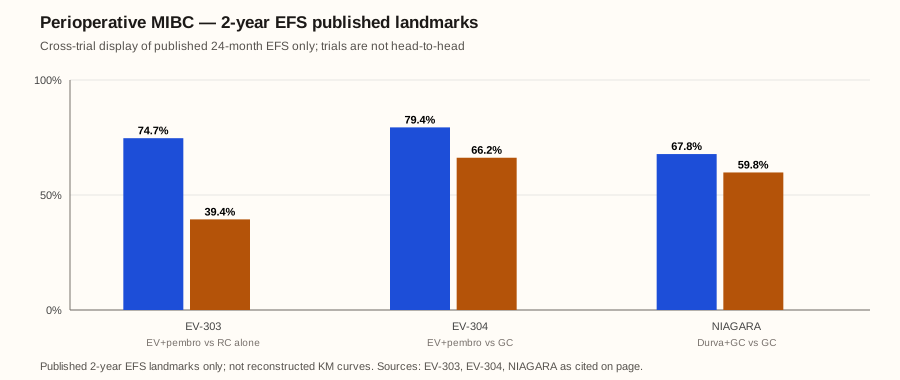
Published 2-year EFS landmarks only across EV-303, EV-304, and NIAGARA; not head-to-head; not reconstructed KM curves123.
Landmark evidence
| Trial | Population | Intervention | Comparator | Primary endpoint | Clinically meaningful outcomes | Generalizability-critical differences |
|---|---|---|---|---|---|---|
| EV-303 / KEYNOTE-905, N=344 | Cisplatin-ineligible or declining MIBC planned for RC+PLND1 | Neoadjuvant EV 1.25 mg/kg days 1,8 plus pembrolizumab 200 mg every 3 weeks ×3 → RC+PLND → adjuvant EV ×6 plus pembrolizumab1 | RC+PLND alone1 | Event-free survival1 | Two-year EFS 74.7% vs 39.4%; two-year OS 79.7% vs 63.1%; EFS HR 0.40; OS HR 0.501. | Specific cisplatin-ineligible/declining population; perioperative, not adjuvant-only, strategy1. |
| EV-304 / KEYNOTE-B15, N=808 | Cisplatin-eligible MIBC2 | Neoadjuvant EV plus pembrolizumab ×4 → RC+PLND → adjuvant EV plus pembrolizumab2 | Neoadjuvant GC ×4 → RC+PLND2 | Event-free survival2 | Two-year EFS 79.4% vs 66.2%; two-year OS 86.9% vs 81.3%; EFS HR 0.53; OS HR 0.652. | Comparator is neoadjuvant GC, not surgery alone2. |
| NIAGARA, N=1,063 | Cisplatin-eligible MIBC3 | Neoadjuvant durvalumab plus GC ×4 → RC → adjuvant durvalumab ×83 | Neoadjuvant GC ×4 → RC3 | Event-free survival3 | 24-month EFS 67.8% vs 59.8%; 24-month OS 82.2% vs 75.2%; EFS HR 0.68; OS HR 0.753. | Perioperative anti-PD-L1 strategy; does not isolate the contribution of neoadjuvant versus adjuvant durvalumab3. |
Biomarkers
| Marker | Current clinic role | Emerging / investigational | How it changes decision now | Limits |
|---|---|---|---|---|
| Cisplatin eligibility | Regimen-selection factor between NIAGARA / EV-304 and EV-303 pathways12356 | Reassessment after obstruction relief56 | Determines whether GC-containing or cisplatin-ineligible perioperative packages apply123. | Do not infer eligibility from one pre-drainage creatinine alone56. |
| Histology / variant | Pathology review and multidisciplinary planning57 | Variant-specific perioperative analyses57 | Flags need for expert review; does not auto-select EV/ICI or GC57. | Variant-specific efficacy for these newer perioperative regimens was not established in the retrieved trials123. |
| PD-L1 | Not a selector for perioperative EV plus pembrolizumab or NIAGARA in the retrieved reports123 | Exploratory correlatives in ICI trials5 | Does not choose among EV-303, EV-304, and NIAGARA on this page123. | No validated perioperative threshold in these sources123. |
| ctDNA | Not standard for selecting neoadjuvant treatment5 | Investigational MRD / perioperative correlatives5 | Do not use it to omit curative-intent local therapy outside a protocol56. | Assay decision thresholds are not practice-ready for neoadjuvant selection here5. |
| Nectin-4 / HER2 / FGFR | Not selectors for perioperative EV/ICI in EV-303, EV-304, or NIAGARA123 | Metastatic biomarker-directed options after recurrence5 | No change to perioperative regimen choice in these trials123. | Do not require Nectin-4/HER2/FGFR positivity to offer labeled perioperative EV plus pembrolizumab124. |
Upcoming research
Field direction: perioperative EV plus pembrolizumab and durvalumab plus GC are now practice standards; longer follow-up and completion rates will refine durability counseling123.
| Trial or publication | Why it may change care | Evidence status |
|---|---|---|
| EV-304 / KEYNOTE-B15 longer follow-up | Clarifies durability and postoperative treatment completion for a perioperative EV plus pembrolizumab strategy against GC2. | Peer-reviewed report; continued follow-up2. |
| NIAGARA longer follow-up | Clarifies durability of the perioperative durvalumab plus GC result3. | Peer-reviewed phase 3 report; continued follow-up3. |
Toxicity
| Regimen and comparator | Trial-level safety outcomes | Selected named toxicities | Counseling focus |
|---|---|---|---|
| Perioperative EV plus pembrolizumab, EV-303 | Grade ≥3 AEs 71.3% vs 45.9%1. | Named-event percentages were not extracted from the retrieved primary source set1. | Promptly report rash, neuropathy, vision changes, thirst/polyuria, or immune-toxicity symptoms; assess postoperative recovery before adjuvant dosing14. |
| Perioperative EV plus pembrolizumab, EV-304 | Grade ≥3 AEs 75.7% vs 67.2%2. | Named-event percentages were not extracted from the retrieved primary source set2. | Use the same EV and immune-toxicity counseling; monitor cumulative neuropathy and glycemic symptoms24. |
| Perioperative durvalumab plus GC, NIAGARA | Grade 3–4 treatment-related AEs 40.6% vs 40.9%3. | Named-event percentages were not extracted from the retrieved primary source set3. | Review cytopenic infection, renal function, neuropathy, and immune toxicity; severe symptoms require urgent assessment3. |
On-treatment monitoring
| SOC/option regimen | Hallmark monitoring toxicity and available rate | Patient action / clinic response |
|---|---|---|
| Perioperative EV plus pembrolizumab, EV-303 | FDA label treatment-arm rates (single-arm label rates; no paired comparator % in the retained label table): rash 54%, grade 3–4 7%; peripheral neuropathy 39%, grade 3–4 3%; increased glucose 72%, grade 3–4 12%; increased creatinine 47%, grade 3–4 8%4. Trial-level grade ≥3 AEs 71.3% vs 45.9% with RC+PLND alone1. | Check neuropathy, skin, glucose, renal function, visual symptoms, and immune-mediated bowel, lung, liver, and endocrine symptoms before each treatment; new numbness/weakness, thirst/polyuria, rash, vision change, dyspnea, or persistent diarrhea requires prompt contact and a pre-dose assessment4. |
| Perioperative EV plus pembrolizumab, EV-304 | FDA label treatment-arm rates (single-arm label rates; no paired comparator % in the retained label table): rash 63%, grade 3–4 12%; peripheral neuropathy 43%, grade 3–4 3%; hyperglycemia 20%, grade 3–4 7%; dry eye 25%, no grade 3–4 event; increased creatinine 49%, grade 3–4 8%4. Trial-level grade ≥3 AEs 75.7% vs 67.2% with neoadjuvant GC2. | Use the same EV and immune monitoring; focus on cumulative neuropathy, glucose, renal function, and visual symptoms before postoperative doses4. |
| Perioperative durvalumab plus GC, NIAGARA | Grade 3–4 treatment-related AEs 40.6% vs 40.9%; a comparable named monitoring rate was not extracted from the retrieved primary source set3. | Check CBC, renal function, electrolyte replacement needs, neuropathy/hearing symptoms, and immune-mediated bowel, lung, liver, and endocrine symptoms. Fever, infection symptoms, dyspnea, severe diarrhea, or reduced urine output needs urgent assessment3. |
Epic phrase
#neoadjuvantmibc
- Counseling: EV-303 perioperative EV/pembro in cisplatin-ineligible MIBC: 2-year event-free survival about 75% vs 39% with RC+PLND alone (EFS HR 0.40 vs surgery alone); 2-year OS about 80% vs 63% with RC+PLND alone (OS HR 0.50). EV-304 cisplatin-eligible: 2-year EFS 79.4% vs 66.2% with neoadjuvant GC (HR 0.53 vs GC). NIAGARA durvalumab plus GC: 24-month EFS 67.8% vs 59.8% with neoadjuvant GC alone (HR 0.68 vs GC); 24-month OS 82.2% vs 75.2% with GC alone (HR 0.75). Regimens are distinct perioperative packages, not sequential.
- Counseling: Reviewed surveillance and de-escalation: complete neoadjuvant then cystectomy then protocol adjuvant doses; post-cystectomy chest/abdomen/pelvis CT every 6 months through 36 months then annually through ~60 months (EAU framework); stop systemic therapy at planned perioperative completion; recurrence → adjuvant page if residual high-risk without prior ICI completion, or metastatic pathway.
- Counseling: Reviewed treatment order: cisplatin-eligible patients may receive perioperative durvalumab plus GC or perioperative EV plus pembrolizumab → cystectomy → the regimen's specified postoperative treatment; cisplatin-ineligible/declining patients have EV-303 support for EV plus pembrolizumab → cystectomy → postoperative EV plus pembrolizumab. These are distinct perioperative strategies, not sequential regimens. ***
- Monitoring: For EV plus pembrolizumab, review numbness/weakness, rash, vision changes, thirst/polyuria, creatinine, and immune symptoms before each dose. The FDA label reports EV-303 treatment-arm rates (single-arm label rates; no paired comparator % in the retained label table): neuropathy 39%, rash 54%, and increased glucose 72%; EV-304 treatment-arm rates: neuropathy 43%, rash 63%, and hyperglycemia 20%. Trial-level grade ≥3 AEs were 71.3% vs 45.9% with RC+PLND alone (EV-303) and 75.7% vs 67.2% with neoadjuvant GC (EV-304). For durvalumab plus GC, monitor CBC, renal function, electrolytes, neuropathy/hearing, and immune symptoms; NIAGARA grade 3–4 TRAEs 40.6% vs 40.9% with GC alone. Promptly report rash, numbness/weakness, vision changes, thirst/polyuria, cough/dyspnea, diarrhea, fever, or other concerning treatment effects. ***
- Decision: *** selects perioperative EV plus pembrolizumab / perioperative durvalumab plus GC / another cystectomy-anchored plan / bladder-preservation evaluation.
- Labs/NGS: CBC, CMP, renal function, glucose, baseline neuropathy/hearing assessment ***.
- Procedures: *** urinary obstruction relief, restaging, cystectomy/PLND planning, and multidisciplinary review.
- Follow-up: *** toxicity review, surgical timing, and postoperative treatment planning.
Guideline references
- NCCN Bladder Cancer
- EAU Muscle-invasive and metastatic bladder cancer guideline
- AUA/ASCO/ASTRO/SUO MIBC guideline
- ESMO bladder cancer guideline
Sources
- Vulsteke et al. (2026). EV-303 / KEYNOTE-905. *New England Journal of Medicine*. PMID: 41707170
- EV-304 / KEYNOTE-B15 (2026). *New England Journal of Medicine*. PMID: 42485627
- Powles et al. (2024). NIAGARA. *New England Journal of Medicine*. PMID: 39282910
- FDA Padcev label, revised 2026
- NCCN Bladder Cancer
- EAU Muscle-invasive and metastatic bladder cancer guideline
- AUA/ASCO/ASTRO/SUO MIBC guideline
- ESMO bladder cancer guideline
Changelog
- 2026-09-22: Replaced post-cystectomy surveillance with EAU CT every 6 months ×3 years then annual through ~60 months; added perioperative 2-year EFS landmark figure; expanded Biomarkers to five-column table; mirrored EAU cadence in paired dotphrase.
- 2026-09-22: Renamed Upcoming trial results to Upcoming research; reframed for ongoing trials and field direction.
- 2026-09-22: Labeled FDA monitoring rates as single-arm label rates and restated trial-level grade ≥3 AEs with named comparators; mirrored comparator-named counseling in the paired dotphrase.
- 2026-09-22: Added line-level source superscripts ([^n]) linked to numbered Sources.
- 2026-09-22: Added Surveillance and treatment de-escalation section; strengthened quantified benefit counseling in dotphrase.
- 2026-09-21: Added FDA-label EV-303 and EV-304 named monitoring rates without transferring metastatic rates into the perioperative setting.
- 2026-09-21: Added cystectomy-anchored therapy sequencing and all-regimen on-treatment monitoring.
- 2026-09-21: Created resectable MIBC neoadjuvant/perioperative setting page with source-linked phase 3 evidence.